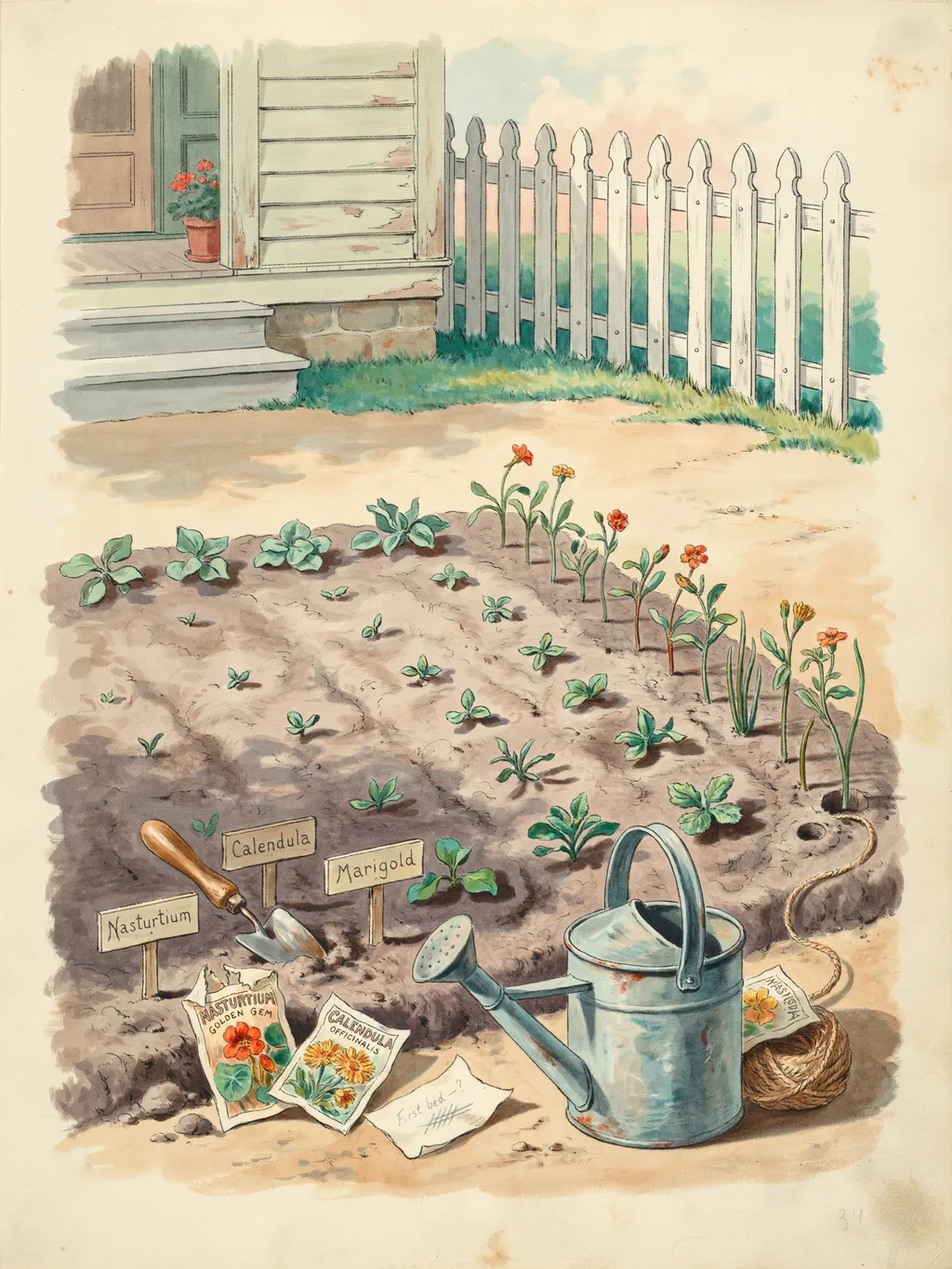
Antique late-19th-century illustrated garden journal page, circa 1895–1905, rendered as a genuine hand-painted watercolor and delicate ink illustration on warm aged cream paper. Clearly painterly, not photographic: visible watercolor washes, softened edges, fine pen-and-ink contours, slight pigment variation, restrained detail, the character of an antique botanical book illustration.
PORTRAIT composition showing a young woman's first spring planting in the small garden of her new Victorian home. Do NOT show the woman herself. Instead, tell her story through the things she has temporarily left beside a freshly prepared flower bed.
A modest newly dug garden bed occupies the lower and middle portion of the composition. Several tiny new seedlings have just been planted, with generous bare earth still visible between them. A few simple handwritten wooden plant markers stand somewhat unevenly in the soil. Nearby are a small hand trowel, an old metal watering can, gardening twine, and two or three opened vintage seed packets with charming illustrated fronts.
Include evidence that she is still learning: one slightly crooked row, a seed packet torn open rather clumsily, one plant marker repositioned leaving a tiny abandoned hole, and perhaps a faint penciled garden note resting nearby with a crossed-out decision or simple question mark.
Along one edge of the bed, include several newly planted nasturtiums, calendula or marigold seedlings. A few orange and yellow blossoms may appear on the seed packets or as very small early flowers, but the garden itself must NOT yet be in full bloom. This is spring beginning, not summer abundance.
Allow a glimpse of the house porch or weathered clapboard siding in the background, plus a section of old picket fence, enough to establish that this is the same modest household garden without turning the image into another broad garden landscape.
Include subtle supporting colors: faded sage and leaf green, warm aged tan and cream, muted charcoal/brown ink, touches of faded robin's-egg blue-green, and one or two very restrained faded purple accents. Yellow and orange remain the principal floral colors but should feel naturally sun-faded rather than bright modern orange.
The mood is cheerful, hopeful, curious and slightly imperfect — a new bride making the first garden that belongs to her, using what she learned in her family's garden but discovering things for herself.
Composition should feel naturally observed rather than staged. Objects may overlap casually. Avoid a symmetrical flat-lay arrangement. Leave breathing room around the illustration and allow areas of warm aged paper to remain visible.
Gently handled antique appearance: soft foxing, faint stains, slight paper discoloration and worn edges, but not heavily distressed.
STYLE REQUIREMENT: authentic antique watercolor-and-ink illustration, painterly realism, visible hand-painted quality, soft washes and drawn linework. NOT photorealistic, NOT photographic lighting, NOT a modern product photograph, NOT hyper-detailed digital realism, NOT glossy, NOT 3D rendered.
No people, no hands, no modern objects, no plastic gardening supplies, no modern typography, no contemporary packaging, no excessive collage layering, no saturated modern colors.