
Use AI to read short-video trends, then turn those signals into sharper hooks, prompts, and cinematic edits with a repeatable production workflow.
Most short-video teams don't have an insight problem. They have a translation problem. A dashboard flags that a particular hook style, cut rhythm, or colour treatment is outperforming, and then a week evaporates while nobody converts that number into a shot list. AI closes part of that gap — but only when it is wired into production rather than parked in a reporting tab.
This guide walks the whole loop: how AI-assisted market analysis actually reads short-video behaviour, how to turn those readings into creative decisions, and how to hand those decisions to a generator such as Orelon without sanding off the detail that made the trend work in the first place.
Why Trend Dashboards Stall at the "So What" Stage
Download rankings and engagement charts describe the past with great precision. They are less useful at telling you what to shoot tomorrow. The gap appears because market data is aggregate and creative decisions are specific. A report can say that nine-second openings with a visible reaction outperform fifteen-second openings with a voiceover. It cannot say what your nine-second opening should contain, which frame to hold, or how the audio should land.
That is the exact seam where AI earns its place. Language models and vision models are good at converting fuzzy descriptive patterns into concrete, testable instructions. They can read fifty captions from outperforming posts and produce a summary of the shared structural mechanic. They can take that summary and write ten prompt variants for a video generator. They cannot decide your brand's tolerance for risk, but they can shrink the distance between observation and draft from days to minutes.
The practical shift is this: stop treating analytics as a reporting function and start treating it as a briefing function. Every insight should leave the dashboard in a form a producer can act on — a variable, a mechanic, and a prompt.
What AI Market Analysis Can and Cannot See
Before you build any workflow, be honest about signal quality. AI-driven analysis of short-video platforms works best on structural and stylistic patterns, and worst on causal claims.
Strong signals
- Pacing fingerprints. Average shot length, cut density in the first three seconds, and whether the payoff arrives before or after the midpoint.
- Hook taxonomy. Whether the opening frame is a face, a texture, a text card, an object in motion, or a question.
- Format clustering. Recognising that forty apparently different posts are the same template with swapped subjects.
- Sentiment and comment themes. Grouping thousands of comments into a handful of recurring reactions, which is far more useful than a single positivity score.
- Competitive feature gaps. Noticing which editing affordances appear in top-performing content and which are absent from your own output.
Weak signals
- Attribution of success to a single element. A trend is almost always a bundle: pacing plus audio plus subject plus posting time.
- Predicting virality. Models can rank relative similarity to past winners, not guarantee distribution.
- Cross-platform comparison without normalisation. A platform with heavier algorithmic recommendation will always look like it rewards different content.
- Anything based on a tiny sample. Ten posts is an anecdote with a chart attached.
A useful rule: let AI describe, let humans decide. Descriptions scale beautifully. Decisions carry accountability and should stay with a person who knows the brand.
The Translation Loop: From Metric to Shot List
This is the core workflow. It takes roughly forty minutes once you have run it twice.
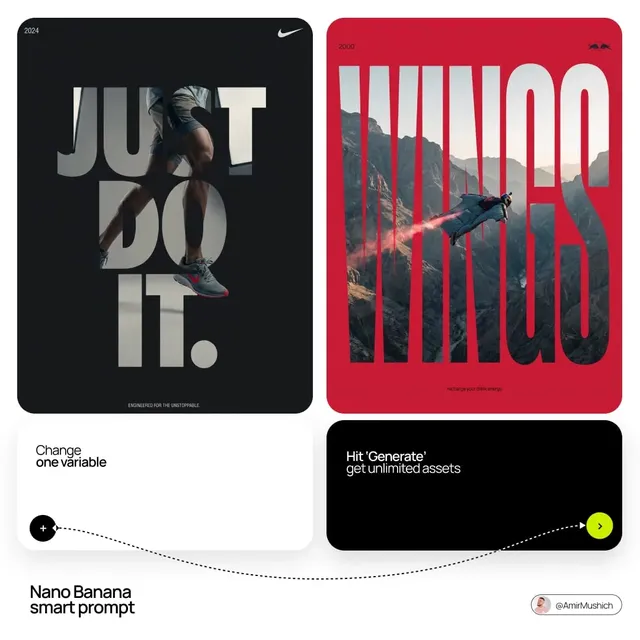
Isolate one variable
Pick a single difference between your outperforming and underperforming set. Not "better content" — something concrete, like "subject enters frame within 0.5 seconds" or "no on-screen text in the first two seconds." If you cannot photograph the difference, it is not a variable yet.
Name the mechanic in plain language
Write one sentence a stranger could understand: "The winning posts delay the reveal until the last second so the viewer's curiosity outlasts their scroll reflex." This sentence is the input to everything downstream. Vague mechanics produce vague prompts.
Write a testable prompt
Convert the mechanic into generation instructions that mention subject, camera behaviour, lighting, pacing, and duration. Keep it under 90 words. Long prompts tend to average out into mush.
Produce variants, not a hero piece
Generate four to six variations in one pass, each changing exactly one element from the mechanic. If everything varies, you learn nothing. A prompt library helps here because reusable scaffolding keeps the comparison honest.
Log the outcome in the same place as the prompt
A prompt without its result is a note to nobody. Keep a simple table: mechanic, prompt, variant changed, performance, next action.
Run this loop once a week and you will accumulate a private library of what your audience responds to — far more valuable than any public trend report.
Reading a Trend Like a Director
Marketers analyse trends as content categories. Directors analyse them as attention mechanics. The second lens travels better across platforms and survives format changes.
Consider a common pattern: fast-cut montages with a hard beat drop at 1.2 seconds. A category reading says "make a montage." A directorial reading says "the edit resolves tension that the first frame created." The first reading dates quickly. The second tells you that if your subject is slow and textural, you need to create the tension elsewhere — a held frame, a sound that cuts early, a colour shift.
When you review a set of high-performing short videos, ask three directorial questions:
- Where is the first unresolved tension? Something must be incomplete in the opening second — a movement not finished, a question not answered, a frame not filled.
- What releases it? The cut, the reveal, the punchline, the sound.
- What would break it? Usually a second of dead air, an unnecessary explanation, or a shot that resolves the tension too early.
Answer these for ten posts and you have a usable grammar. Then write generation prompts in that grammar rather than in the vocabulary of a trend name. Image work often helps at this stage: generating a few stills to test whether a lighting or composition idea reads at thumbnail size is much cheaper than generating video and discovering it does not. The AI image generator is a reasonable place to run that check first.
Prompt Patterns That Survive a Trend Cycle
Trends decay. Structural prompt patterns do not. A few that stay useful across genres:
The tension-first pattern. Open on an incomplete action, hold it, then resolve within the clip. Example: "Close on hands tightening a strap, frame held, subject enters from left and the camera drifts to follow, warm backlight, shallow depth of field, 6 seconds."
The texture-then-context pattern. Start on an abstract surface, pull back to reveal the setting. Useful when your subject is unglamorous but your lighting is strong.
The single-motion pattern. One continuous camera move, no cuts. This reads as premium and avoids the uncanny stitching that plagues over-ambitious multi-beat generations.
The negative-space pattern. Deliberately leave a third of the frame empty for text or product overlay later. This is a production convenience disguised as a style choice, and it saves enormous rework.
The colour-anchor pattern. Assign one dominant colour to the first second and return to it at the end. It creates a subconscious sense of completion that viewers feel without noticing.
Write each pattern once, then vary subject and lighting per campaign. Templates help if you produce at volume — a video template is essentially a pre-solved prompt with the variables exposed.
A Weekly Review Cadence That Sticks
Daily trend-chasing produces reactive content and burned-out editors. Weekly is the sweet spot, with a lightweight daily capture habit.
Daily, ten minutes. Save links to anything that stops your scroll, with a one-line note on why. No analysis. Capture only.
Midweek, thirty minutes. Run the saved items through an AI summary with a specific instruction: identify recurring structural mechanics, not topics. You want "held frame before reveal," not "more cooking content."
Weekly, sixty minutes. Pick one mechanic, run the translation loop, generate variants, schedule them. Archive everything else.
Monthly, forty-five minutes. Review the log. Which mechanics produced work that held attention past three seconds? Which prompts consistently produced artefacts? Retire what failed without sentiment.
The cadence matters more than the tooling. A team with a plain document and a disciplined Friday review will outperform a team with an expensive analytics suite and no ritual.
Where AI Tools Divide the Work
It helps to be explicit about which part of the pipeline each tool owns, because overlapping tools create duplicated effort.
Analysis layer. Spreadsheet plus a general-purpose model is usually enough. Feed it captions, comment themes, and your own performance data. Ask for pattern clustering, not verdicts.
Concept layer. A model works well as a sparring partner for naming mechanics and proposing variations. Keep the brief short and insist on concrete nouns.
Generation layer. A dedicated video model handles text-to-video, image-to-video, and style consistency. Orelon is built around cinematic idea-to-motion work, which suits teams producing short-form with a visual signature rather than clip-art explainers.
Assembly layer. Editing, sound design, and captions still live in a traditional editor. Do not attempt to finish inside the generator unless the piece is genuinely a single shot.
Distribution layer. Scheduling and captioning tools. These produce the numbers that feed the analysis layer next week, closing the loop.
If you are comparing generation options, it is worth reading side-by-side breakdowns — for example Orelon vs Runway or Orelon vs Kling AI — because camera-motion control and consistency behave differently across models, and that difference directly affects which trend mechanics you can realistically execute.
Mistakes That Flatten Results
Chasing the subject instead of the mechanic. Copying the topic of a viral post produces derivative work with none of the underlying tension. Copy the structure, change the subject.
Over-prompting. Twenty-line prompts usually produce average results because conflicting instructions cancel out. Six specific instructions beat twenty hedged ones.
Ignoring the first frame. Most short-video platforms decide relevance from the opening moments. If your generated clip has a soft, ambiguous first frame, everything after it is wasted effort.
Treating a model's output as final. Generation gives you raw material with unusual texture. The edit is where pacing is decided, and pacing is what audiences respond to.
Measuring only views. Save rate and rewatch rate tell you far more about whether a mechanic worked than raw reach, which is heavily influenced by distribution luck.
No archive. Teams that don't log prompts re-solve the same problems quarterly. The log is the asset.
Measuring Whether the Loop Works
You do not need a sophisticated measurement stack, but you do need three metrics that map to the loop itself.
Insight-to-publish time. How long from identifying a mechanic to shipping content that uses it. If this is longer than a week, the loop is broken somewhere in review, not in analysis.
First-three-second retention. The single most honest signal of whether a hook mechanic transferred from observation to execution.
Variant hit rate. The proportion of generated variants that survive your own internal review. A rate below one in four usually means prompts are too vague; a rate near one in one means you are not testing anything.
Track these monthly rather than per post. Per-post variance is noise; monthly direction is signal.
FAQ
Do I need a specialist analytics tool to do this?
No. A spreadsheet of your own posts plus a general-purpose model covers most of the analysis. Specialist tools help at scale, but the bottleneck for most teams is the translation step, not data collection.
How many posts should I analyse at once?
Twenty to fifty per platform is a workable range. Fewer than twenty and you are pattern-matching on coincidence; more than a hundred and the summaries start averaging away the useful specifics.
Can AI reliably predict which video will go viral?
Not reliably. It can estimate stylistic similarity to past high-performers and flag weak openings, which is genuinely useful for quality control. Distribution depends on factors outside any model's view.
How do I keep AI-assisted content from looking generic?
Constrain harder on the things models default to. Specify lens behaviour, light direction, and one deliberately unusual element. Generic output usually comes from an unconstrained prompt, not from the tool.
Should the analysis and generation happen in the same tool?
They can, but there is no strong reason to force it. The analysis layer changes slowly; generation models change quickly. Keeping them separate lets you swap either without rebuilding the workflow.
What if my niche has no visible trends?
That is often an advantage. Slow-moving niches reward structural mechanics — pacing, framing, sound — because the mechanics stay valid for months instead of days.
Turn Your Next Insight Into Motion
Trend analysis only pays off when it ends in footage. The next time a pattern catches your attention, resist the urge to write a strategy note. Name the mechanic in one sentence, write a short prompt around it, and generate four variants before the day ends. You will learn more from four honest tests than from a month of reporting.
Start with the AI video generator to turn a mechanic into a moving frame, browse the Orelon blog for workflow patterns that hold up over time, and keep your best prompts where the whole team can reach them. Cinematic ideas move fastest when the distance between observation and output is measured in minutes.