
Learn how prompt AI image generators work, how to structure prompts that survive variation, and how to carry an approved still into a cinematic AI video shot.
Ask ten people what makes a strong image prompt and you will get ten answers, most of them shaped by whichever generator they tried first. The advice is rarely wrong, but it is almost always incomplete, because it describes one tool's quirks rather than a repeatable process. What separates a usable frame from a wasted afternoon is not vocabulary. It is a workflow: a way of describing a shot, testing it cheaply, and carrying the result into motion without losing the look you approved.
This guide lays that workflow out end to end. You will see how prompt-driven generation works under the hood, how to structure prompts that hold up across dozens of variations, how to move an approved still into a moving shot, and where most people quietly lose quality without noticing.
What a Prompt AI Image Generator Actually Does
A prompt-driven generator is a translation layer between intent and a probabilistic renderer. Your sentence becomes a numerical representation, a denoiser works inside a compressed latent space, and a decoder reconstructs pixels from the result. Generation is really a guided cleanup: start from noise, steer toward the concept your words describe, stop when the image resolves into something stable.
That framing matters practically because it explains why word order, specificity, and redundancy change your output. Every token competes for attention. A prompt that reads "red car, blue car, green car" forces the model to blend contradictory instructions instead of choosing one. A prompt that reads "a single vintage coupe in deep signal red, parked on wet asphalt" gives the denoiser a single target to converge on.
The Pipeline in Plain Terms
The text encoder is where phrasing becomes structure. Nouns and named styles tend to anchor composition. Adjectives adjust surface qualities like color and material. Verbs imply pose or motion. This is why a prompt built almost entirely from adjectives reads as foggy: there is nothing structural for the model to hold onto.
Latent space is the compressed middle ground where the heavy work happens. Denoising a small latent grid is far cheaper than denoising full-resolution pixels, which is why a single frame can appear in seconds. The tradeoff shows up at the end, when fine details are reconstructed. Tiny objects degrade first: jewelry clasps, text on signage, thin cables, fingers. If your shot depends on one of those, plan for extra attempts or generate it at a larger relative scale inside the frame.
The denoising loop runs a fixed number of steps. More steps are not automatically better. Past a certain point you are paying for refinement the model cannot deliver, and you may lose the natural texture that made early steps look photographic.
Why the Same Words Produce Different Pictures
Three forces cause drift. First, the seed: the starting noise pattern changes when and where structure appears. Second, sampling randomness: some tools add small stochastic variation per step. Third, version drift: hosted models get updated quietly, and captioning styles change with them.
This is not a flaw to defeat. It is a property to plan around. If you keep a log of prompt, seed, and settings, drift becomes a manageable variable instead of a mystery. If you do not, every good result feels like an accident and every bad one feels like the tool's fault.
A Prompt Framework You Can Reuse Under Deadline
Think of prompt writing as filling slots in a deliberate order. Once the order becomes habit, you stop writing prose and start writing specifications.
| Slot | The question it answers | Example fragment |
|---|---|---|
| Subject | Who or what | a night-shift baker in a flour-dusted apron |
| Action | What is happening | sliding a tray of rolls from a deck oven |
| Setting | Where and when | a cramped tiled kitchen before dawn |
| Lens | How it is framed | 35mm, medium shot, shallow focus |
| Light | Where light comes from | one warm overhead bulb with hard falloff |
| Craft | What it should feel like | muted amber palette, fine grain, photoreal |
Read the fragments as one sentence and you have a prompt. Swap a single layer and you have controlled variation rather than a new experiment.
Filling the Slots in Sixty Seconds
Here is the whole process compressed. Start with the subject and make it specific but not overloaded: "a night-shift baker" beats "a person" and also beats "a baker with a wooden leg, three scars, a pipe, and a red cap," which is five competing details fighting for the same rendering budget.
Give the frame an action, even for a portrait. "Mid-laugh," "turning to look back," "pulling a tray from the oven" all create an implied moment, and an implied moment is what makes a still extensible into motion later.
Establish depth with your setting. Name the environment and one or two grounding details: flour dust in the air, wet cobblestones, a fluorescent office ceiling. Depth cues tell the model how to stage the scene behind and in front of your subject.
Then add lens, light, and craft. The light should have a source and a direction. The lens should tell the model how far away the camera is. Craft language sets palette and texture. In practice the whole prompt might read: "night-shift baker sliding a tray of rolls from a deck oven, steam curling upward, cramped tiled kitchen before dawn, 35mm medium shot, one warm overhead bulb with hard falloff, flour dust in the air, muted amber palette, fine grain, photoreal." That is roughly forty words, and it contains exactly one of everything.
Vary One Layer, Keep the Rest
Because the slots are independent, you can generate a consistent coverage set instead of a pile of unrelated images. Hold lens and light fixed, change only the action: pulling the tray, wiping the counter, looking toward the window. The result looks like four shots from the same scene rather than four different projects.
Specificity Without Overloading
The most common failure is not a bad idea. It is a prompt that asks the renderer to resolve a contradiction. Models resolve contradictions by averaging them, and averages look bland and slightly wrong.
| Too vague | Useful middle | Too crowded |
|---|---|---|
| a woman in a room | a woman reading a letter by a rain-streaked window | a woman reading a letter while cooking, crying, laughing, in a storm |
| a city at night | empty crosswalk in neon-lit rain, one figure waiting | a cyberpunk metropolis with crowds, cars, rain, fire, and a sunset |
The middle column is not the longest. It is the one where every word can coexist in one frame at one moment. That is the test to apply: could a photographer set up this shot and capture it in a single exposure? If not, the model will guess, and its guess will involve blending.
Describe What the Camera Sees, Not What the Scene Means
"Melancholy" is a feeling. "Overcast light, muted teal shadows, an empty bus shelter at dawn" is something a renderer can build. Emotional adjectives tend to raise contrast and saturation rather than create actual atmosphere, because that is the visual pattern they are associated with in training data.
If you want a mood, name the physical conditions that produce it: direction of light, color temperature, weather, emptiness, distance. The feeling arrives as a side effect, and it usually arrives stronger.
The Three-Detail Rule
For faces and products, decide on three details that identify the subject and leave the rest to a reference image. Words are good at framing and light. They are poor at identity. If the same face or the same product has to appear across multiple frames, generate a clean reference image first and reuse it, and use your written prompt to control angle, lens, and lighting around it.
Camera and Light Language That Raises Perceived Quality
Lens language is the fastest way to make a generated frame feel deliberate, because it changes the geometry of the shot rather than adding decoration.
Lens Choices and What They Signal
A 24mm wide with a low horizon suggests scale and isolation. A 35mm feels observational and slightly documentary. A 50mm is neutral and honest. An 85mm compresses the background and flatters faces, especially with shallow depth of field. A 100mm macro turns texture into the subject. Tilt-shift reads as miniature. Anamorphic reads as widescreen cinema, with flares and a softer edge.
Aspect ratio deserves a decision before you write a word. A vertical frame pushes you toward one centered subject. A very wide frame invites environment and negative space. If you set an ultra-wide composition and then discover the deliverable is vertical, you will rebuild the shot from scratch.
Lighting Setups You Can Name
Instead of adjectives, name a source and a direction. A single soft key from the left with deep shadow falloff. Hard overhead noon sun. Backlight with a rim on the shoulders. Practical neon from the right, cool and slightly green. Ambient bounce from a white wall. Window light through a sheer curtain, flat and diffused.
Directional light nearly always reads as more cinematic than flat ambient light, because it creates a visible decision about where the viewer should look.
Palette, Texture, and Restraint
Pick one palette direction per shot: warm amber interior, cool cyan night, desaturated grey-green overcast, high-contrast monochrome with one color accent. Mixing two palettes produces muddy midtones and a frame that feels unresolved.
Texture language matters more in video than in stills. Fine grain, halation, and slight lens softness help a generated clip blend with real footage. Clean digital renders can look unnaturally crisp next to live-action plates, especially in motion.
From Approved Keyframe to Moving Shot
The most reliable route into AI video runs through a still image. You iterate cheaply on the frame first, approve it, then animate. This splits one hard problem into two tractable ones.
Lock the Look Before You Move Anything
Use an AI image generator to produce a keyframe that already matches the final composition, color, and lighting. That frame becomes your reference and your contract with yourself. If the still is wrong, the clip will be wrong, no matter how elegant the motion prompt is.
Save the prompt, seed, and settings for that frame. You will need them again when a shot fails three scenes later and you have to rebuild it.
Write Motion as Two Separate Tracks
When you animate the keyframe, describe camera behavior and subject behavior separately. The camera track covers slow push in, lateral tracking left, locked-off tripod, handheld drift, crane down, slow orbit. The subject track covers hair moving in wind, steam rising, a hand reaching toward a handle, a coat flapping, a curtain lifting.
Vague motion words such as "dynamic," "energetic," or "cinematic movement" hand the model freedom it will spend badly. One clear camera move plus one clear subject action beats five adjectives, every time. Keep the first generation modest: a slow push with a single subject action is easy to evaluate, and you can push harder once the base works.
Hold Continuity Across a Sequence
Continuity comes from reused references, not from hope. Keep the same light direction, palette, and lens family across shots so the sequence reads as one world. If a character appears repeatedly, build a small reference sheet: neutral front view, three-quarter view, and one expression. Reuse it instead of re-describing the person in words each time.
Where a sequence needs consistent pacing and transitions, starting from a video template keeps the structural decisions settled so you can concentrate on content.
Reproducibility: Seeds, Settings, and a Prompt Log
The difference between people who improve quickly and people who plateau is almost always record-keeping, not talent. A prompt log turns luck into a library.
What to Record
For each accepted frame, note the prompt, the seed, the aspect ratio, guidance strength, step count, model version, and a one-line verdict about what worked. A simple spreadsheet is enough. Within a month you will have a personal reference of what performs for your specific subject matter: your faces, your products, your environments.
Change One Variable at a Time
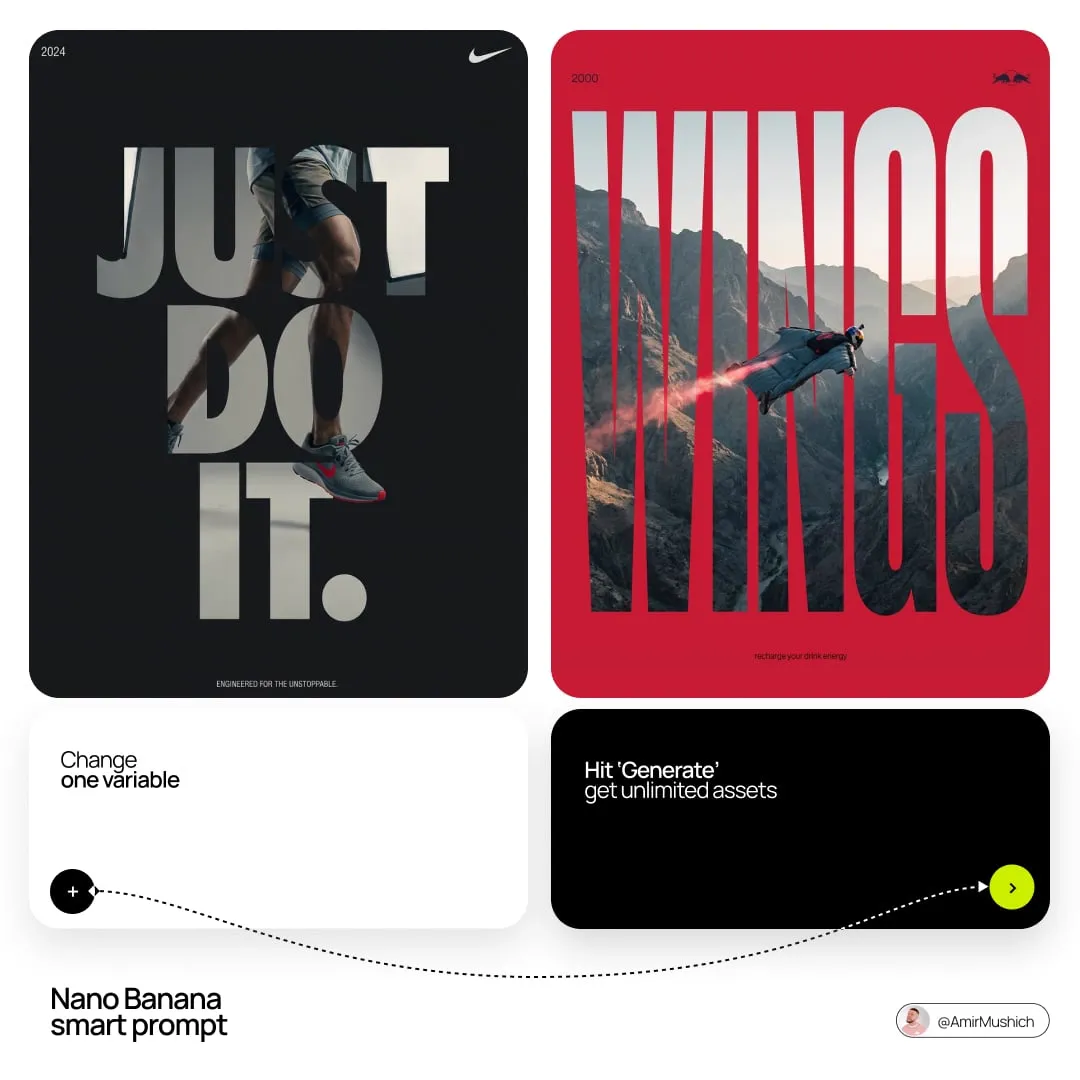
If you change subject, lens, and light simultaneously, the result teaches you nothing. Change the light, compare, then change the lens. This feels slower for one image and is dramatically faster for the next fifty, because you learn which lever moves which quality.
Select in Batches, Not One at a Time
Generate four to eight variations of the same prompt with different seeds and scan them as a contact sheet. Pick the strongest frame and iterate from its seed. Choosing one image at a time biases you toward whatever appeared first, which is rarely the best option in the batch.
Four Worked Examples
Product Hero Shot
Prompt: "matte ceramic coffee cup on a dark stone counter, steam rising, three-quarter view, 85mm macro, single soft key light from the left, deep shadow falloff, muted warm palette, photoreal." The steam gives the animator something to move, the macro lens gives the texture somewhere to live, and the single light source keeps the frame from turning muddy.
Cinematic Cold Open
Prompt: "lone figure in a rain-soaked overcoat at the end of an empty pier, back to camera, wide 24mm shot, low horizon, overcast dawn light, desaturated blue-grey palette, fine grain, anamorphic feel." Back to camera means there is no face to render badly, and the wide frame leaves room for a slow push in without cropping the subject.
Abstract Explainer Visual
Prompt: "cluster of translucent geometric nodes connected by thin light filaments, floating in dark space, centered composition, soft volumetric glow, cool cyan and amber accents, clean 3D render style." Abstract visuals are forgiving of small artifacts and animate smoothly because the motion is implied by the structure itself.
Character Dialogue Beat
Prompt: "two figures facing each other across a cluttered desk in a dim office, medium two-shot, 50mm, single desk lamp between them, warm pool of light with hard falloff, muted brown palette, photoreal." Generate a clean reference for each figure first, keep the lamp position identical across shots, and animate only small movements: a head turn, a hand gesture, a shift in posture. Restraint here is what makes the scene feel directed.
Mistakes That Quietly Ruin Strong Ideas
Most failures are structural rather than creative. The recurring ones:
- Stacking conflicting light sources. Two directions of hard light plus practical neon gives the model three instructions and one compromise.
- Writing a story instead of a frame. "She remembers her childhood" has no composition. "She stares at a photograph on a windowsill" does.
- Blending two art styles. Painterly and photoreal pull in opposite directions, and the average is neither.
- Asking for legible text inside the image. Generate the visual clean and add typography in your editor, where you control layout and spelling.
- Deciding aspect ratio last. Composition and format are the same decision.
- Reusing a winning prompt on a new subject without updating the lens slot. The lens is what made the original work.
- Trusting one good seed without saving it. A great frame you cannot reproduce is a screenshot, not a workflow.
- Overloading the negative prompt. Long lists of exclusions dilute each other and can suppress legitimate detail. Keep exclusions specific to a failure you actually saw.
All of these share one root cause: the prompt asks the renderer to resolve a contradiction, and the renderer answers by averaging.
Choosing a Tool: Decision Criteria That Matter
Feature lists are a poor guide because every product claims the same capabilities. Judge on four things instead.
Control fidelity. Can you hold composition, lighting, and identity across generations, or does every render drift in a new direction? Test this by generating six variations of one prompt and checking whether they look like the same scene.
Iteration speed. How fast is the loop between idea and evaluation? A slow loop discourages experimentation, and experimentation is where quality comes from.
Still-to-motion fidelity. Does the animated clip actually resemble the keyframe you approved, or does it reinterpret the frame? This is the single most important test for anyone building sequences rather than one-off images.
Output flexibility. Aspect ratios, clip duration options, and a clean export into your editing timeline. A tool that produces beautiful frames you cannot cut together is a demo, not a pipeline.
A Thirty-Minute Evaluation Protocol
Pick one shot you actually need. Write a six-slot prompt. Generate eight variations, note the seed of the best one, then animate it with one camera move and one subject action. If the clip still resembles the keyframe and the export drops cleanly into an editor, the tool fits your workflow. If you spend the thirty minutes fighting the interface or re-rolling seeds blindly, it does not.
When a Specialist Beats a Generalist
General tools are usually enough for landscapes, abstract visuals, product stills, and mood pieces. Specialists tend to win on three narrow problems: photoreal human faces across multiple shots, precise product geometry with readable branding, and long takes that need sustained motion coherence. Recognize which problem you actually have before switching tools, because the switch has its own learning cost. A structured comparison of AI video generator alternatives is a faster starting point than a dozen disconnected demo reels, and it keeps the evaluation focused on workflow instead of marketing claims.
FAQ
Do longer prompts always produce better images?
No. Length helps until instructions start competing. A dense forty-word prompt with one subject and one lighting scheme beats a hundred-word prompt describing three possible scenes.
Should I write prompts in my own language?
Most modern tools handle major languages well, and writing in the language you think in often produces more natural phrasing. If a specific tool performs noticeably better with English prompts, write the core prompt in English and keep your notes in your own language so your log stays readable.
How many attempts should I budget for a usable frame?
For simple subjects, one to three rounds. For a specific face, fine product detail, or an unusual composition, expect six to ten. Budgeting for that reality makes the process feel normal instead of broken.
Why does my animated clip look different from my keyframe?
Usually because the motion prompt asked for something the frame cannot support: a camera move with no room to travel, or a subject action that contradicts the pose. Keep the first generation modest, then push once the base works.
Can I reuse one prompt across different tools?
Partly. Subject, action, and setting transfer well. Lens and craft language transfers unevenly, because each model was trained on different captioning styles. Keep your log organized per tool.
How do I keep a character consistent across shots?
Use a reference image rather than a description. Build a small sheet with a neutral front view, a three-quarter view, and one expression, then reuse it. Words are unreliable for identity and reliable for framing and light.
Do I need to understand technical parameters to get good results?
No, but you need to control them consistently. The practical minimum is seed, aspect ratio, and guidance strength. Recording those three turns a lucky render into a repeatable one.
What about text inside images?
Generate the visual without text and add typography in post. Text rendering keeps improving, but layout control and spelling reliability still favor your editor.
Start With One Shot
Prompt work is a craft with a short feedback loop. Every log entry, every rejected frame, and every controlled variation teaches you something a tool cannot tell you directly. The goal is not the perfect prompt. It is a process that reliably gets you to an approved frame and then into motion.
You do not need a dozen ideas to start. Pick the one shot you have been meaning to build, describe it in six slots, generate a batch, and pick the strongest seed. Then take that approved frame into an AI video generator and give it one camera move and one subject action. If you would rather begin from proven structures, browse the prompt library and adapt what already works, and keep your own notes as you go.
Orelon is built for that arc: cinematic ideas in motion. Start on the Orelon homepage, refine your still, then push the frame you approved into a moving shot. One well-structured prompt is enough to see how far the workflow takes you.