Effects by Tags
Dramatic Cello Sonata Poster
Likes
1
Views
32
 Orelon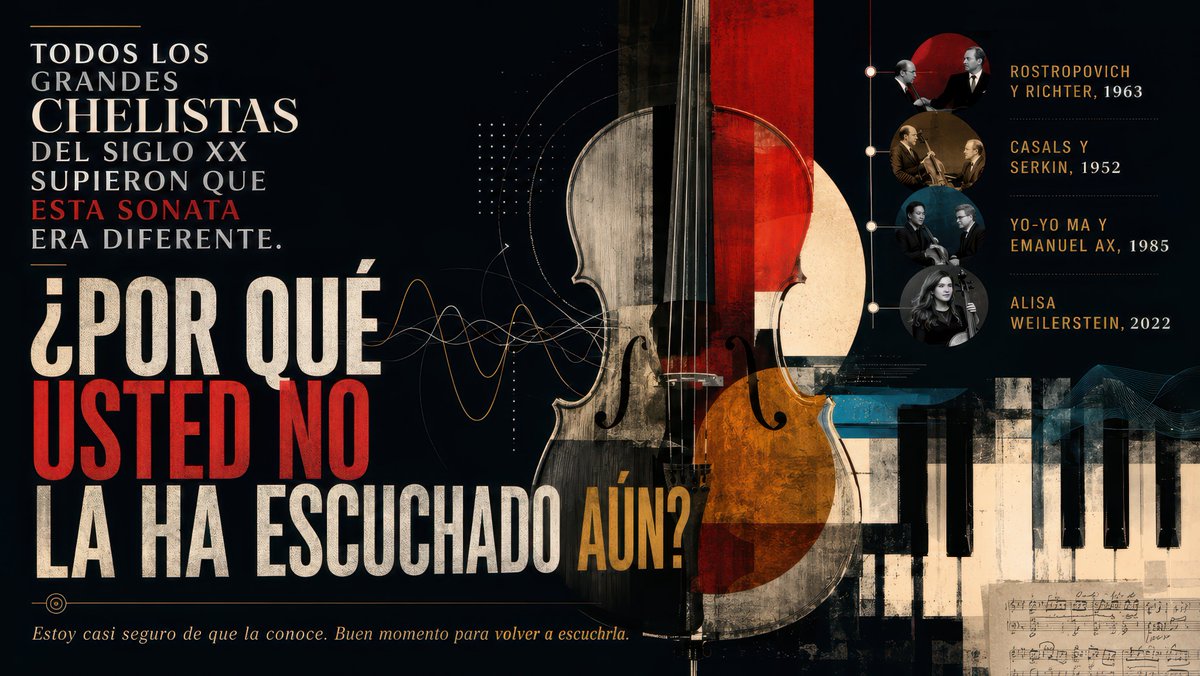
Effects by Tags
Goal: Create a dramatic widescreen editorial poster about a famous cello sonata and its legendary performers, in Spanish, with a classical-music documentary mood. Canvas: 16:9 horizontal poster, dark charcoal-black background, aged paper texture, high contrast, cinematic lighting, distressed ink and collage grain. Layout: Left third contains the main Spanish typography in stacked uppercase lines. Center features an oversized vertical cello collage, partly transparent and split into worn cream wood, black, deep red, and amber-orange geometric overlays. Bottom right contains a cropped piano keyboard extending horizontally, with a small fragment of handwritten sheet music beneath it. Right third contains a vertical timeline of recordings with exactly 4 circular musician-photo medallions connected by a thin vertical line and small nodes. Add subtle sound-wave curves, dotted grids, fine technical arcs, and faint music-staff textures around the cello. Text content: Use this exact main headline on the left, with mixed white, cream, red, and gold emphasis: “TODOS LOS GRANDES CHELISTAS DEL SIGLO XX SUPIERON QUE ESTA SONATA ERA DIFERENTE.” Then very large: “¿POR QUÉ USTED NO LA HA ESCUCHADO AÚN?” Make “USTED NO” bright red, “AÚN?” gold, and the rest distressed cream-white. Bottom left italic sentence: “Estoy casi seguro de que la conoce. Buen momento para volver a escucharla.” Right-side timeline: Include exactly 4 labeled recording entries, stacked vertically, each aligned to one circular portrait medallion: 1) “ROSTROPOVICH Y RICHTER, 1963”; 2) “CASALS Y SERKIN, 1952”; 3) “YO-YO MA Y EMANUEL AX, 1985”; 4) “ALISA WEILERSTEIN, 2022”. The medallions should look like archival classical-musician photos with muted sepia, black-and-white, and blue-gray tones; the final portrait can be a modern grayscale female cellist image. Visual style: Sophisticated museum-poster design, bold condensed serif and slab-serif typography, grunge print texture, vintage concert-program aesthetic, elegant gold accents, red circular sun shape behind the top timeline portraits, thin lines and dots like a music-analysis diagram. The cello should dominate the composition and overlap the typography slightly without making the text unreadable. Customizable parameters: The subject sentence may be {argument name="main claim" default="TODOS LOS GRANDES CHELISTAS DEL SIGLO XX SUPIERON QUE ESTA SONATA ERA DIFERENTE."}; the large question may be {argument name="headline question" default="¿POR QUÉ USTED NO LA HA ESCUCHADO AÚN?"}; the closing line may be {argument name="footer quote" default="Estoy casi seguro de que la conoce. Buen momento para volver a escucharla."}; the instrument focus may be {argument name="central instrument" default="cello"}; the timeline title names may be {argument name="recording list" default="Rostropovich y Richter, 1963; Casals y Serkin, 1952; Yo-Yo Ma y Emanuel Ax, 1985; Alisa Weilerstein, 2022"}. Constraints: Keep all text legible and spelled exactly as specified, do not add extra recording entries, do not add logos or watermarks, maintain a dark refined classical-music poster atmosphere.
This is a free AI prompt from the Orelon library. Thousands more image prompts here are free to copy and adapt.
Explore more image prompts



Ready to create
Start with this curated direction in Orelon, then shape it into your next visual.