
Short-form video rewrote how audiences find creators. Here is a practical AI-assisted workflow for scripting, generating, and editing vertical clips.
Short-form video is usually described as a format. It behaves more like a contract: you borrow a stranger's attention for a few seconds, and you owe them a reason to keep watching. Every element of a vertical clip — the first frame, the cut rhythm, the caption style, the loop at the end — exists to keep that contract from breaking.
That is why the format spread faster than almost any other change in online video, and why so many skilled long-form creators stall when they try it. Their craft transfers. Their structure does not. A ten-minute essay earns attention through accumulation; a thirty-second clip has to earn it before it has said anything at all.
This guide looks briefly at where vertical short-form came from, then focuses on the part that changes outcomes: a repeatable production workflow, including where AI generation genuinely helps, how to prompt for it, and how to tell whether a clip deserves to be published.
Where the vertical format came from
Short-form video existed long before any single platform made it dominant. Six-second comedy loops proved that a tiny runtime could carry a complete idea. Early mobile editing apps proved that creators would shoot, cut, and publish from a phone instead of a desk. What was missing was distribution: the subscription feed rewarded channel loyalty, not discovery.
The shift happened when platforms rebuilt their home surfaces around algorithmic, full-screen, swipeable feeds. Vertical video stopped being a compromise for phone shooters and became the primary surface where new audiences meet new creators. The short-form feature that arrived on YouTube — first as a limited beta in India before expanding globally — was a response to that surface change, not a filmmaking experiment. Its subsequent history is a history of distribution decisions: dedicated shelves in the app, creator funds, and eventually a shared revenue model for the format.
The practical takeaway is not a launch date. It is that the format's rules were set by the feed, not by cinema. Vertical is watched on a device held in one hand, often with sound off, usually by someone who arrived by accident. Everything in your production process should assume that.
What short-form actually rewards
Four properties separate clips that travel from clips that die quietly.
Immediate legibility. The first frame has to be understandable at a glance, at thumbnail size, with no context. If a viewer needs the caption to know what they are looking at, you have already lost most of them. A working heuristic many editors use: if you cannot describe the frame in four words, it is not a first frame.
Retention per second, not per minute. In long-form, a slow minute can be recovered by a strong act two. In short-form, a slow second is terminal. This changes how you write: every line has to justify the next three seconds, and any sentence that only sets up a later sentence gets cut.
Rewatch value. Short clips are cheap to replay, and replays are a strong signal. Loops, visual density, and small details that reward a second look all lift a clip without changing its idea.
Native craft. Audiences have learned to read vertical video fluently. They notice mismatched captions, horizontal footage letterboxed into a vertical frame, audio that clips, and lighting that looks like a laptop screen. Polish here is not vanity; it is the price of being taken seriously.
Building a repeatable short-form pipeline
Most creators do not fail because of a lack of ideas. They fail because every clip is a one-off production, so output collapses the moment life gets busy. A pipeline fixes that by turning each clip into a small set of decisions made in the same order every time.
Write the one-line pitch before anything else
Force the idea into a single sentence with a subject, a tension, and a payoff: "A chef shows why restaurant pasta tastes better — and the reason is one ingredient most home cooks skip." If the sentence needs a comma splice to survive, the clip will too.
Script the first three seconds as a shot, not a line
Openers fail when they are written as words and only later assigned a picture. Write them as images: a hand pulling a pan off the heat, a before/after split, a wrong result held up to camera. Then write the line that goes with it.
Build a shot list that survives a vertical frame
Vertical crops punish wide shots. Plan coverage that works in a 9:16 frame: close-ups, hands, faces, product inserts, top-down scenes, and movement toward or away from camera. If you shoot horizontal for a longer piece, plan the vertical version at the same time — framing a subject slightly off-center leaves room for a clean 9:16 crop later.
Generate or capture the B-roll that is missing
This is the step where most small teams get stuck. The script calls for a city at night, an abstract data flow, a slow-motion splash, or a historical interior, and shooting it is impossible on a phone. AI generation closes that gap in minutes rather than days.
Edit for silence, not for length
New editors cut until the clip hits a target duration. Experienced ones cut until nothing remains that is not doing work: dead air before a sentence starts, filler words, pauses that do not build tension. Then they check the runtime. A clip that lands at twenty-two seconds is finished; one padded to thirty is not.
Package for the platform
Captions, a title that adds information rather than repeating the audio, a thumbnail frame chosen deliberately, and a sound level checked on a phone speaker. Packaging is the last ten percent of the work and the first thing audiences judge.
For teams running a series, starting from an existing video template keeps pacing and safe-zone layout consistent across episodes, which is what makes a feed feel like a channel rather than a folder of experiments.
Batching ten clips in one working session
Short-form punishes creators who produce one clip at a time. The setup cost — finding the idea, choosing the structure, opening the editor — is repeated ten times instead of once. Batching moves that cost to the front and drops the marginal effort of each additional clip.
Build an idea bank before you need one
Keep a running list of one-line pitches, captured the moment they occur to you. Twenty pitches is roughly two weeks of publishing. The list removes the blank-page problem entirely and lets you judge ideas by comparing them instead of evaluating each one in isolation.
Write all the scripts in one sitting
Script five to ten clips back to back while you are in the same headspace. Patterns become obvious: you will notice that four of them open the same way, which is either a signature or a rut, and you can decide which.
Run a single generation block
Generate every missing insert for the whole batch in one session. Consistency improves because you are reusing the same lighting and camera language while it is fresh in mind, and because you can compare variants side by side instead of remembering yesterday's attempt.
Edit in a block, publish on a schedule
Edit the batch together with a shared caption style and audio bed, then schedule the clips across the week. Publishing daily from a batch is sustainable. Publishing daily by producing daily is not.
Repurpose what already exists
A single long-form video usually contains five to eight short-form ideas: a strong objection, a surprising number, a demonstration, a mistake, a story fragment. Cutting those out is faster than writing new ideas, and the clips act as trailers that send viewers back to the long version.
Where AI generation fits in a vertical workflow
AI video has an uneven reputation because it is often used for the wrong job. It is weak at replacing a talking head that needs authentic presence. It is strong at the jobs that stop small creators from publishing at all. A simple split helps:
| Shot need | Better source | Why |
|---|---|---|
| Presenter speaking to camera | Practical | Authenticity and natural lip sync |
| Abstract concepts (growth, friction, signal) | Generated | No practical equivalent exists |
| City at night, aerial, weather | Generated | Expensive to shoot, cheap to generate |
| Hands demonstrating a tool | Practical | Detail, texture, and continuity |
| Historical or impossible setting | Generated | Effectively the only option |
| Recurring visual motif across a series | Generated | Reproducible consistency |
Beyond shot sourcing, three habits make AI useful rather than decorative. Generate 9:16 natively so you stop compromising between a horizontal master and a cropped vertical version. Regenerate the same visual motif across episodes so a series feels intentional. And generate several variants of an opening shot rather than one, because in short-form the first frame does more work than any other decision you will make.
If you want to see how that looks in practice, the AI video generator is the fastest place to test whether a shot idea is achievable before committing to a shoot day. Still frames and thumbnails are often faster to explore with an AI image generator first, then animated once the composition works.
Five short-form structures that hold up
Structure is what keeps a thirty-second clip from becoming a random sequence of nice frames.
The cold-open demonstration
Start mid-action with the result visible, then rewind to explain. Works because the payoff is shown before it is promised, so nothing has to be taken on faith.
The misconception flip
State the belief the audience holds, show why it fails, then give the correction. Efficient because the hook is built into the tension — no separate attention device required.
The loop
End on the frame you opened with, or on a line that makes the start mean something different. Loops earn replays, and replays are the cheapest growth a clip can get.
The before/after
Two states, one cut, minimal narration. Extremely strong when the transformation is visual and the time gap is honest.
The three-beat explainer
One claim, one example, one limitation. Three beats fit comfortably in twenty to forty seconds and resist the temptation to over-explain.
Pick one structure per series and repeat it. Variety inside a format reads as range; variety of format reads as inconsistency.
Prompting for cinematic vertical clips
A prompt that produces a usable clip usually specifies subject, action, camera, light, and mood — in that order. Vague prompts produce generic movement, which is the fastest way to make generated footage look generated.
Close-up of rain hitting a dark car hood, shallow depth of field, slow push in, cold blue streetlight from the left, wet reflections, cinematic, 9:16 vertical, no text.
Four habits make prompting faster:
- Describe motion, not just content. "Slow push in," "handheld drift," and "whip pan reveal" produce more usable results than scene descriptions alone.
- Name the light. Direction and color temperature do more for realism than any adjective about quality.
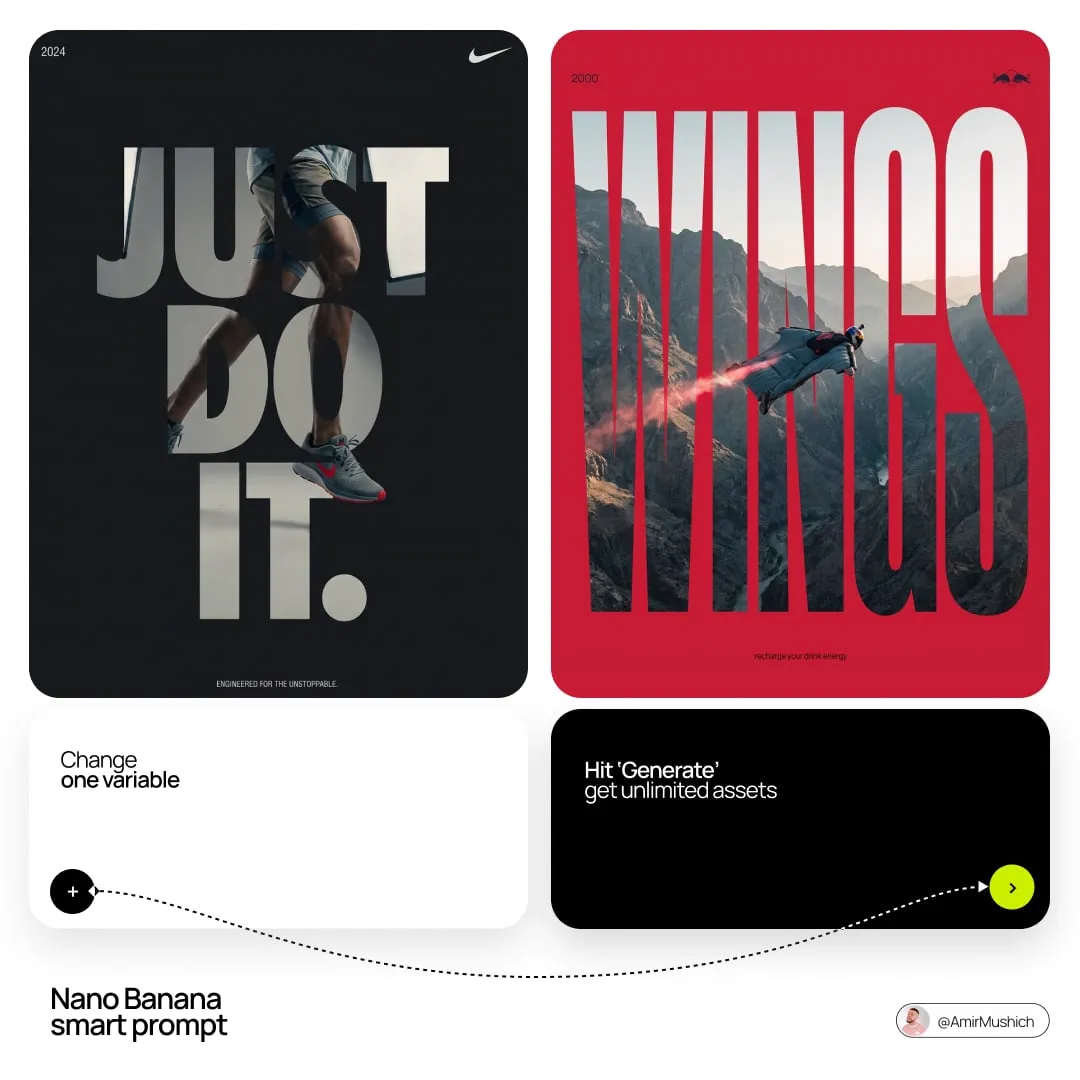
- Iterate one variable at a time. Change the camera or the light, never both, or you will not know what worked.
- Keep prompts you can reuse. A saved library of openers and transitions is worth more than a single lucky generation. The prompt library is a good place to build that habit.
Generate three to five seconds at a time. Short-form editing rarely needs longer continuous shots, and shorter clips give you more choices for the same effort.
Editing rules and the pre-publish check
Vertical video has its own grammar, and most of it is about legibility on a small screen.
- Respect the safe zones. Platform interfaces cover roughly the top ten percent and the bottom twenty percent of the frame. Keep faces and captions in the middle band.
- Caption in two lines maximum. Long caption blocks force the eye to stop reading the image.
- Cut on motion. Cuts during movement hide themselves; cuts during stillness feel like errors.
- Normalize audio once. Loudness consistency across a series matters more than absolute volume.
- Design the mute experience. Most viewers start silent. If the clip only works with sound, add a visual that carries the same information.
The four-question test
Run the same questions every time, and answer honestly. Does frame one read without context? Is there a promise in the first three seconds, and is it paid off? Would you watch it a second time? Does it look like it belongs beside the best clips in this niche? Any "no" is a fix, not a footnote. The most common failure is a strong clip with a weak first frame — cheap to fix and expensive to ignore.
Mistakes that quietly limit reach
Optimizing for length instead of rhythm. Trimming to hit a target duration produces clips that feel rushed and incomplete at the same time.
Mixing formats inside one series. Different aspect ratios, caption styles, and pacing between episodes makes a channel feel accidental.
Using AI for the wrong shot. Generated footage works best for inserts and atmosphere, and worst when it is asked to carry a human performance.
Ignoring the audio bed. Silence under a voiceover is fine; a music track that fights the voice is not.
Publishing without a retention check. Watch your own clip with the sound off and a stopwatch. If you would swipe away, so would everyone else.
FAQ
Does vertical video need to be shot vertically? No, but it needs to be framed for vertical. If you shoot horizontal, compose with the crop in mind and capture a second set of close-ups for the vertical version.
How long should a short-form clip be? As long as the idea needs and no longer. Most structures land between fifteen and forty-five seconds; a three-beat explainer rarely justifies more.
Can AI-generated footage look native in a short-form feed? Yes, when it is used for inserts, atmosphere, and transitions with consistent lighting and grain, and when it is cut with the same rhythm as captured footage. Mismatched motion speed is what usually gives it away.
Do I need a different edit for each platform? Usually only the packaging: title, caption style, and safe zones. The clip itself can stay the same if it was framed with enough margin.
What should a beginner build first? A series of five clips in a single structure with a single visual style. Consistency teaches you more than variety does at the start.
How do I keep quality up when publishing frequently? Batch. Write, generate, and edit in blocks, then publish on a schedule. Weekly batching produces better clips than daily scrambling, because every decision is made with a clear head.
Make the next clip the one that ships
The history of short-form video is really a history of attention moving to a new surface — and every time that happens, the creators who win are the ones with a workflow that survives a busy week. Pick one structure, script the first three seconds as a shot, generate the footage you cannot shoot, and cut until nothing unnecessary remains.
Orelon is built for that loop: cinematic ideas in motion, generated natively in vertical, ready to drop straight into an edit. Start with a single opener, compare a few variants, and keep the one that makes you stop scrolling.