

Build a free AI video ad workflow that works: shot planning, prompt structure, batch creative testing, brand consistency, audio tips, and honest budget notes.
Marketing teams rarely lose campaigns because nobody had a good idea. They lose because one polished video costs more time than ten rough ones, and every performance channel rewards the team that tested ten. Generative video has collapsed that cost curve, and the free entry points are now strong enough to build real campaigns on — as long as you understand where they shine and where they quietly fall apart.
This guide is a working manual rather than a feature tour. You will see how to structure prompts, plan shots before spending generation allowance, batch-test creative, keep a brand recognizable across dozens of clips, and decide when a heavier paid model is genuinely worth the extra spend.
Why free AI video ad generation changed the marketing math
Video advertising used to sit at the top of a production pyramid: script, cast, location, shoot, edit, color, mix, deliverables. Every layer added cost and calendar time, which meant a lean team could afford two or three concepts per quarter. The predictable result was a portfolio of precious, over-polished spots that nobody dared to replace even after they fatigued into irrelevance.
Generative video breaks that pyramid into cheap, repeatable steps. A hook can be tested in six different framings before lunch. A product shot can be regenerated with new lighting instead of rescheduled. The bottleneck moves from production capacity to judgment: knowing which variant deserves the next round of spend and which is quietly cannibalizing your best performer.
Three shifts make this possible now rather than two years ago:
- Text-to-video became conversational. You describe a shot in plain language, iterate on the description, and receive a usable clip in seconds to minutes instead of days.
- Free tiers became functional. A limited daily allowance is usually enough to produce a complete short ad if you plan shots before you generate anything.
- Existing assets became reusable. Image-to-video and video-to-video let you animate a product photograph or restyle archival footage instead of starting from a blank canvas.
The catch is that free access changes your constraints rather than removing them. You are optimizing for a small number of generations, so planning discipline matters more, not less. A team that plans six shots and rerolls three of them will outproduce a team that improvises sixty prompts and keeps whatever looks decent.
What free actually means in AI video practice
Free describes at least three different situations, and mixing them up is the fastest way to waste a week of production time.
Daily allowances and trial access
Most hosted platforms give new accounts a daily or one-time generation allowance, often with a watermark, a lower resolution ceiling, or a slower queue at peak hours. That is genuinely enough for a 15 to 30 second ad if every generation is intentional. It is not enough to brute-force a good clip by requesting fifty options and hoping one lands.
Open-weight models on low-cost hosting
Some of the strongest video models are reachable through community endpoints, per-second billing, or self-hosted inference. This is the best route for teams with technical capacity: predictable costs, full control over resolution and duration, and the ability to re-run an entire shot list overnight. If you can write a script that submits jobs in a queue, your testing velocity doubles without adding headcount.
The costs that never appear on a pricing page
The real expense of AI advertising is rarely generation:
- Editor time. Someone still cuts, captions, and exports platform-native versions. This is usually the largest line item.
- Iteration overhead. Every prompt rewrite is a decision, and undirected iteration burns both allowance and attention.
- Brand drift. Without reference images and a locked style guide, your tenth clip will not look like your first.
- Review cycles. Legal, brand, and local market reviewers each add a loop. Batch your review requests rather than sending them one clip at a time.
Budget for those four before you budget for model access. A free pipeline with sloppy review habits is more expensive than a paid pipeline with tight ones.
The anatomy of a short ad that converts
Attention is scarce and front-loaded. Viewers decide in roughly the first two seconds whether a clip deserves the next ten, so the structure of a generated ad should be brutally simple.
Hook, promise, proof, prompt
- Hook (0 to 2s): one visual idea, unmistakable. A hand opening a box, a plate hitting water, a UI element snapping into place, a lid popping off.
- Promise (2 to 6s): the outcome in plain language. Not revolutionary — specific. 'Cold coffee at 4pm' beats 'elevate your ritual.'
- Proof (6 to 15s): demonstration. Product in use, before-and-after, a number on screen, a texture close-up.
- Prompt (15 to 25s): a single low-friction next step. One verb, one destination.
AI models are excellent at hooks and proof shots because those are visual. They are mediocre at argument because argument is verbal. Keep persuasion in your script and captions, and let the model handle imagery. Teams that ask a video model to explain a value proposition usually get beautiful footage attached to a muddled message, which performs worse than plain footage with a clear line of copy.
A free AI ad workflow, step by step
The workflow below produces one finished ad plus three variants without exhausting a typical daily allowance.
Step 1: Write the script before touching a generator
Draft 25 seconds of copy, roughly 55 to 70 words. Write the hook as a single sentence you could shout across a room. If you cannot summarize the ad in one line, no model will rescue the concept. Read it aloud and cut every adjective that is not doing work.
Step 2: Storyboard six shots
Six shots is the sweet spot for a 25-second ad: hook, context, product, proof, detail, call to action. For each shot write one line containing subject, action, camera, and light. Then mark which shots can be reused across variants — usually the product and proof shots, which are expensive to regenerate and rarely the reason a variant wins or loses.
Step 3: Match the model to the shot, not the campaign
Product close-ups with fine detail favor models with strong image-to-video fidelity. Fast, stylized movement favors models tuned for temporal coherence. Ambient and atmospheric scenes are the easiest ask and can run on the cheapest option available. Working examples in a prompt library show how camera, light, and motion language fit together, and ready-made templates shorten the learning curve when you are starting from zero.
Step 4: Generate the hardest shots first
Order matters. Generate the two shots most likely to fail — usually the rotation, the pour, or a hands-on-object moment — while you still have allowance left to pivot. If a shot fails badly, switch to image-to-video from a still photograph, which gives you exact control of composition and lighting.
Step 5: Assemble, caption, and export
Drop clips into your editor, trim to the beat, add burned-in captions, and export vertical, square, and landscape versions. This is where a clip becomes an ad; raw generated footage almost never converts on its own. Cutting two frames earlier on the hook routinely outperforms a full regeneration, and it costs nothing.
Step 6: Keep three variants alive
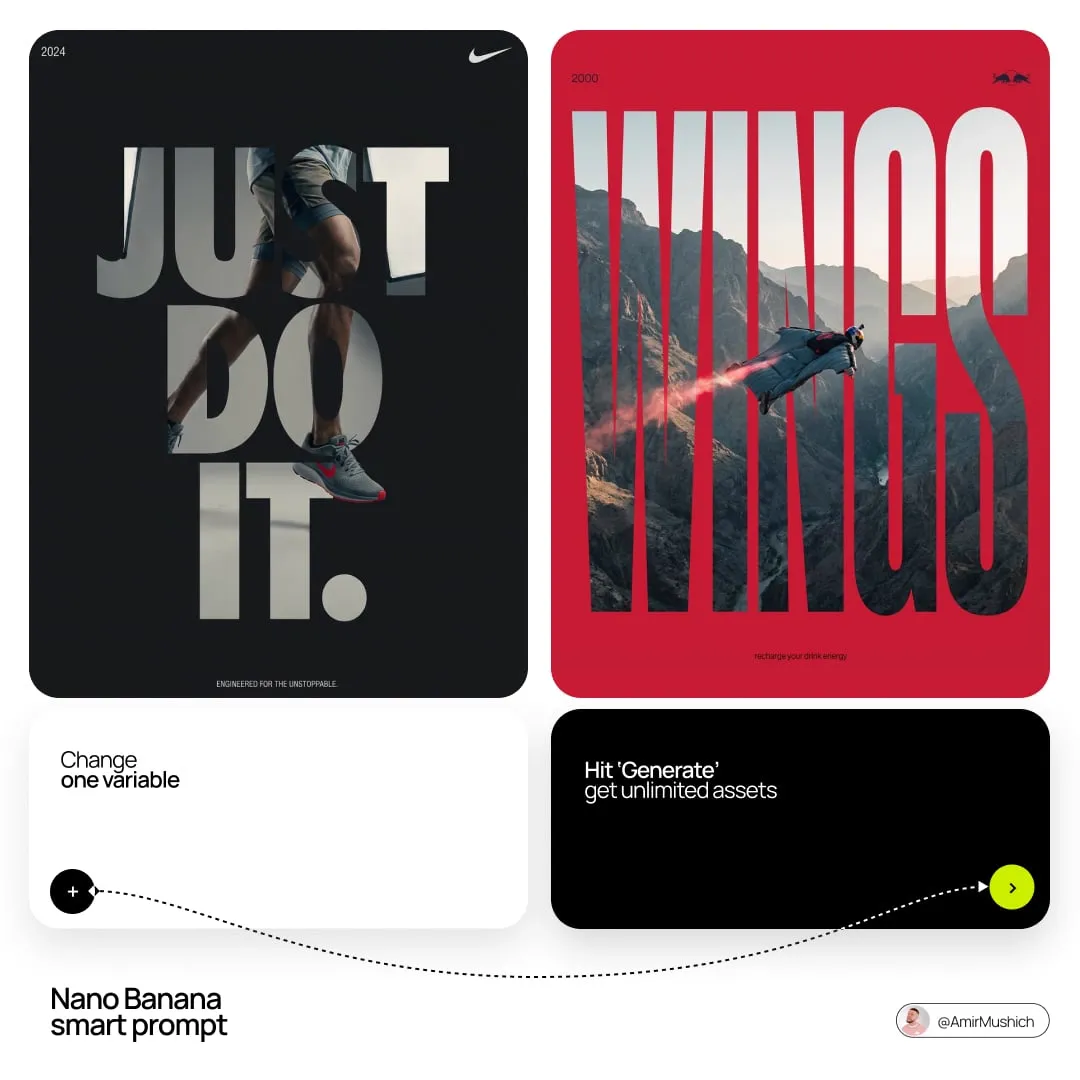
Change one variable at a time: hook framing, opening line, or payoff shot. Three variants per concept is enough to learn something without diluting your sample size across so many cells that no result reaches significance.
A worked example: 25-second refillable bottle ad
Here is what a planned shot list looks like for a refillable bottle aimed at commuters, written the way you would actually paste it into a generator.
- Shot 1 (hook, 2s): macro shot, condensation on brushed steel, hand enters frame from the right, window light from the left, shallow depth of field.
- Shot 2 (context, 3s): commuter on a platform, bottle in a backpack side pocket, morning light, subtle handheld feel.
- Shot 3 (product, 4s): tabletop shot, bottle rotating slowly on concrete, soft light from above, no text in frame.
- Shot 4 (proof, 6s): ice dropping into the bottle, water pouring, slow motion, hard light behind to catch spray.
- Shot 5 (detail, 4s): close-up of the lid threading on, fingers only, natural light.
- Shot 6 (CTA, 4s): bottle on a desk beside a laptop, screen glow, slow push-in.
Generate shots 3 and 4 first. Reusable shots cost nothing to carry into the next variant, so only the hook and the call to action need fresh generation when you test a new angle. That single decision is what makes a three-variant test affordable on a free allowance.
Batch testing creative without a research budget
The advantage of cheap generation is statistical, not aesthetic. You want more swings, not a more beautiful swing.
Name and version every asset
Use a consistent convention such as concept-hookvariant-audience-v3. When a winning combination emerges, you should be able to reconstruct exactly which hook, which model, and which edit produced it. Teams that skip naming lose their learning within a week and quietly re-run the same experiments a month later.
Measure the boring metrics
- Hook rate: share of viewers still watching at three seconds.
- Completion rate: for short ads, often a better proxy for message clarity than click-through.
- Cost per result: compare across variants, including editor time.
- Fatigue curve: how quickly a variant decays tells you whether the concept or the execution was weak.
- Thumb-stop ratio: on feeds with thumbnails, isolate how much of your performance comes from the still frame.
Be disciplined about test design. If you change the hook, the music, and the opening line at once, you learn nothing even when one variant wins. Change one variable per round, hold the rest fixed, and give each variant enough impressions to produce a stable hook rate before judging it. Cutting a test short is the most common reason teams abandon a concept that was actually working.
Keeping brand identity consistent across generated frames
The classic failure mode of AI advertising is a set that looks like five different brands stitched together. Consistency comes from constraints, not luck.
Lock a reference set. Create three to five reference images: logo placement, palette in context, product angles, and one representative person if you use talent. Feed them as conditioning references whenever the model supports it.
Write a reusable style suffix. Something like soft daylight from the left, shallow depth of field, muted palette, no text in frame. Append it to every prompt. It costs nothing and eliminates half your outliers.
Separate style from content. The suffix stays constant; only subject and action change per shot. This also makes variants comparable, because the visual language is held fixed while the message moves.
Standardize the intro and outro in the editor. Build the branded open and close with vector assets, not with the model. Generated logo animations wobble and shift; vector ones do not.
Audit in contact-sheet form. Before editing, lay every clip on one screen. Outliers become obvious when they sit next to their neighbors, and it takes two minutes instead of twenty.
Protect one rule above all. If your brand depends on a specific color and a specific typographic feel, never let the model invent either. Generate imagery, typeset text.
Sound and voice: the cheapest quality upgrade
Audio is the most neglected layer in AI ad production and the cheapest to improve.
- Voice: pick one voice and keep it across a campaign. Voice consistency does more for perceived production quality than visual fidelity.
- Music: a single track with a clear drop at your hook, trimmed so the beat lands on the cut rather than a beat after it.
- Ambience: room tone, a product click, fabric movement, a lid turning. Small sounds hide the uncanny smoothness of generated motion.
- Silence: half a second of quiet before the hook is one of the most effective attention devices available, and it is free.
If generation consumes your allowance, generate video first and handle audio with conventional tools. Nobody has ever complained that an ad's music was not AI-generated. Sound also gives you a cheap variant axis: the same visuals with two different opening lines is effectively two ads for the price of one edit pass.
Choosing a model: a decision framework
Model choice matters less than shot planning, but it still matters. Use this rough framework to decide where to spend your limited generations.
| Situation | What to prioritize | Practical approach |
|---|---|---|
| Product close-up with fine detail | Image-to-video fidelity | Any model with reference-image conditioning |
| Fast, stylized motion | Temporal coherence | Models tuned for dynamic movement |
| Realistic people | Identity stability | Models with subject reference support |
| Long ambient shots | Duration and cost | Cheapest per-second option available |
| Talking-head delivery | Lip-sync accuracy | Dedicated avatar tools, not general video models |
If you are weighing platforms, comparison pages are more useful than feature lists because they foreground trade-offs. An alternatives overview helps you map which capabilities you actually need before committing to a subscription, and once your shot list is ready, Create Video keeps generation and iteration in one place.
Common mistakes that waste free generation allowance
Generating before storyboarding. The most expensive habit in the whole workflow. Every unplanned generation is a guess, and guesses multiply fast.
Changing three variables between variants. You learn nothing, then blame the model for a result your test design could never have revealed.
Accepting the first good clip. Good is not the same as on brand. Check every clip against your style suffix and reference set before it enters the edit.
Ignoring the first second. A beautiful ad that opens on a slow logo animation loses most viewers before the product appears.
Forgetting platform formats. A widescreen masterpiece cropped to vertical rarely survives the reframing. Frame for your tightest aspect ratio first, then expand.
Skipping captions. A large share of viewers watch muted, and an unsubtitled ad is effectively a silent film.
Over-investing in one hero video. Ten tested variants beat one polished hero in almost every performance channel, including ones where you would not expect it.
Leaving the deliverable to the end. Export specs, file naming, and caption burns should be defined before the edit starts, not discovered the morning a campaign is supposed to launch.
FAQ
Can free AI video tools really produce ads good enough to run? Yes, for short-form social placements, provided you treat generation as one step in a pipeline rather than the whole pipeline. Captions, pacing, and audio still do the heavy lifting.
How many generations does one ad need? A disciplined 25-second ad usually needs 12 to 20 generations to yield six usable shots, because you will reroll motion, framing, or artifacts. Planning shots up front is what keeps that number low.
Text-to-video or image-to-video? Image-to-video for anything product-related, because you control composition and lighting from a real asset. Text-to-video for atmospheric b-roll, conceptual hooks, and background scenes.
Do generated ads damage brand trust? Not inherently. Audiences respond to clarity and specificity. What damages trust is inconsistency: mismatched color, wobbly text, and voices that change between clips.
Should I use one model or several? Several, chosen per shot. Locking yourself to one model is convenient but usually means accepting weaker product shots or unnatural motion somewhere in the finished ad.
How do I keep costs predictable? Plan shots, cap rerolls per shot, and generate b-roll at lower resolution, upscaling only the clips that survive the edit. Track editor hours separately from generation, because that is where budgets actually break.
What about rights and disclosure? Check the commercial terms of whichever model you use, keep records of generated assets, and follow platform rules on synthetic media disclosure. When in doubt, disclose, and keep a dated record of what was generated when.
How long before I know if a variant works? Long enough to see a stable hook rate across several days and at least one full day-part cycle. Judging a variant on a single afternoon of delivery is the fastest way to kill a concept that had legs.
Start with one concept, not one campaign
The realistic path is small: one concept, six planned shots, three hook variants, and five days of testing. That produces more usable learning than a month of tool comparison, and it costs almost nothing but attention. Once the loop feels routine, expand to two concepts per week and let the data decide what deserves a bigger production.
When you are ready to move from reading to generating, Orelon is built for exactly this rhythm — describe a cinematic idea, generate the shots, and iterate until the cut holds together. Start with your first shot list in Create Video, then browse the blog for more workflow breakdowns before you spend another generation.