


A practical system for building a personal brand with short video: positioning, visual consistency, scripting, AI-assisted production, and measurement.
Short video is the shortest path between being good at something and being known for it. A forty-second clip can accomplish what a portfolio page, a press mention, and a carefully worded introduction cannot do at the same time: it shows how you think, how you sound, and whether spending more time with you is worth it. The editing, the colour, and the tool you choose matter only because they protect those three signals.
What follows is a production system for building a personal brand with short video. It covers positioning, a repeatable visual signature, script architecture, the decision of what to generate versus what to film, a weekly workflow that survives a real calendar, and the handful of measurements that tell you what to make next. AI appears where it genuinely shortens the distance from idea to finished frame — and where it quietly erodes the thing you are trying to build.
Why short video became the front door for personal brands
Text explains an idea. Video demonstrates a person. That difference is why founders, consultants, physiotherapists, illustrators, and engineers who built their earlier reputation on written posts now treat vertical video as their front door. A viewer does not evaluate your qualifications in the first three seconds; they evaluate whether you sound like someone who has done the work.
Discovery mechanics reinforce the format. Recommendation systems test every clip on a small group first, so a tight forty seconds of genuine value can travel further than a twenty-minute upload that only existing subscribers ever see. Completion, rewatch, and shares act as the signals that decide whether a second, larger group sees it at all. You do not need an audience to begin; you need a clip that holds attention long enough to be worth showing to one more person.
There is also a quieter benefit that rarely gets mentioned: short video is a compression exercise. Explaining your work in sixty seconds forces you to find the sharpest version of your argument. Those sentences become your bio, your landing page headline, your proposal opening, and the first thirty seconds of a client call.
The recognition loop: from stranger to follower
Growth in short video is not a funnel, it is a loop with four stages. First, a stranger stops because the first frame or the first sentence creates a small unresolved question. Second, they stay because the middle pays that question off with something specific. Third, they feel a flicker of familiarity — the same face, the same lighting, the same type of promise. Fourth, they deliberately return, because they now expect you to be useful again.
Every stage has a different failure mode. Weak hooks lose stage one. Vague middles lose stage two. An inconsistent look loses stage three, even when the content is good, because nothing signals that this clip and the last one came from the same person. Losing stage four usually means your clips are enjoyable but not about anything you can name in a sentence.
Positioning before production
Most weak personal brand videos are not badly produced. They are undecided. They attempt to be useful, funny, personal, and promotional in the same sixty seconds, and the viewer leaves with no idea what to expect next.
The one-sentence promise
Complete this frame: I help [specific audience] get [specific outcome] by [method or point of view]. Then attack it. If a competitor in your field could say the same sentence word for word, you have written a category description, not a position. Sharpen it with a constraint you are willing to defend — an audience you do not serve, a method you avoid, or a belief your peers would push back on. “I help independent clinics fill quiet weekday slots without discounting” is a position. “I help businesses grow with marketing” is a banner.
Three rules you can actually check
Voice guidelines fail when they are aspirational. Make them mechanical: one idea per video; no hype adjectives; always name one concrete example or number; never explain a term you would not say out loud. Keep the list to three and read every script against it before you shoot. Consistency of voice is what makes a stranger feel, by the fifth clip, that they already know you.
Three pillars, rotated
A rotation that works for almost every expert brand is teach, prove, person. Teach delivers a usable method in under a minute. Prove shows evidence — a result, a failure, a before-and-after, a client's exact words with permission. Person reveals judgement: an opinion, a small admission, a decision you made this week and why. Rotating pillars keeps a feed from becoming a lecture series, and it gives you a repeatable answer to the hardest question in content: what do I post next?
A concrete example. A freelance motion designer with three pillars might post a 35-second breakdown of how they storyboard a fifteen-second ad (teach), a 50-second teardown of a project that missed its deadline and what changed afterwards (prove), and a 30-second opinion on why most brand animation looks the same (person). Three clips, one promise, one recognisable voice.
Designing a visual signature you can repeat
Recognition beats novelty. A viewer should know a clip is yours before the caption confirms it. That is not a creative limitation; it is how recall works.
Character consistency is a technical requirement
If you appear on camera, keep framing, wardrobe palette, lens choice, and light direction constant. Small variations read as personality; large ones read as a different person. If you use a generated presenter or an animated identity, consistency stops being a stylistic preference and becomes a specification. Fix three to five reference angles, one wardrobe description, one hairstyle, one lighting setup, and reuse that identity block in every generation. When a result drifts — a slightly different jawline, a wider lens, a colder mood — regenerate it rather than repairing it in the edit, because drift is exactly the signal you are trying to eliminate.
Light, colour, framing
One key light, one practical in the background, one dominant colour. That is enough. A warm key with a cool rim, or soft window light against a dark room, becomes a signature after a dozen clips. Grading every clip the same way does more for recall than a more expensive camera. The same logic applies to generated footage: choose a palette and hold it, even when a brighter, punchier look is available for a single shot.
The identity block and prompt craft
The most common reason generated visuals look generic is that the prompt describes a mood instead of a camera. “Beautiful cinematic shot” is a wish. “Medium close-up, 50mm, subject centre-left looking slightly off-camera, warm key from the right, deep shadow behind, shallow depth of field, no text in frame” is an instruction.
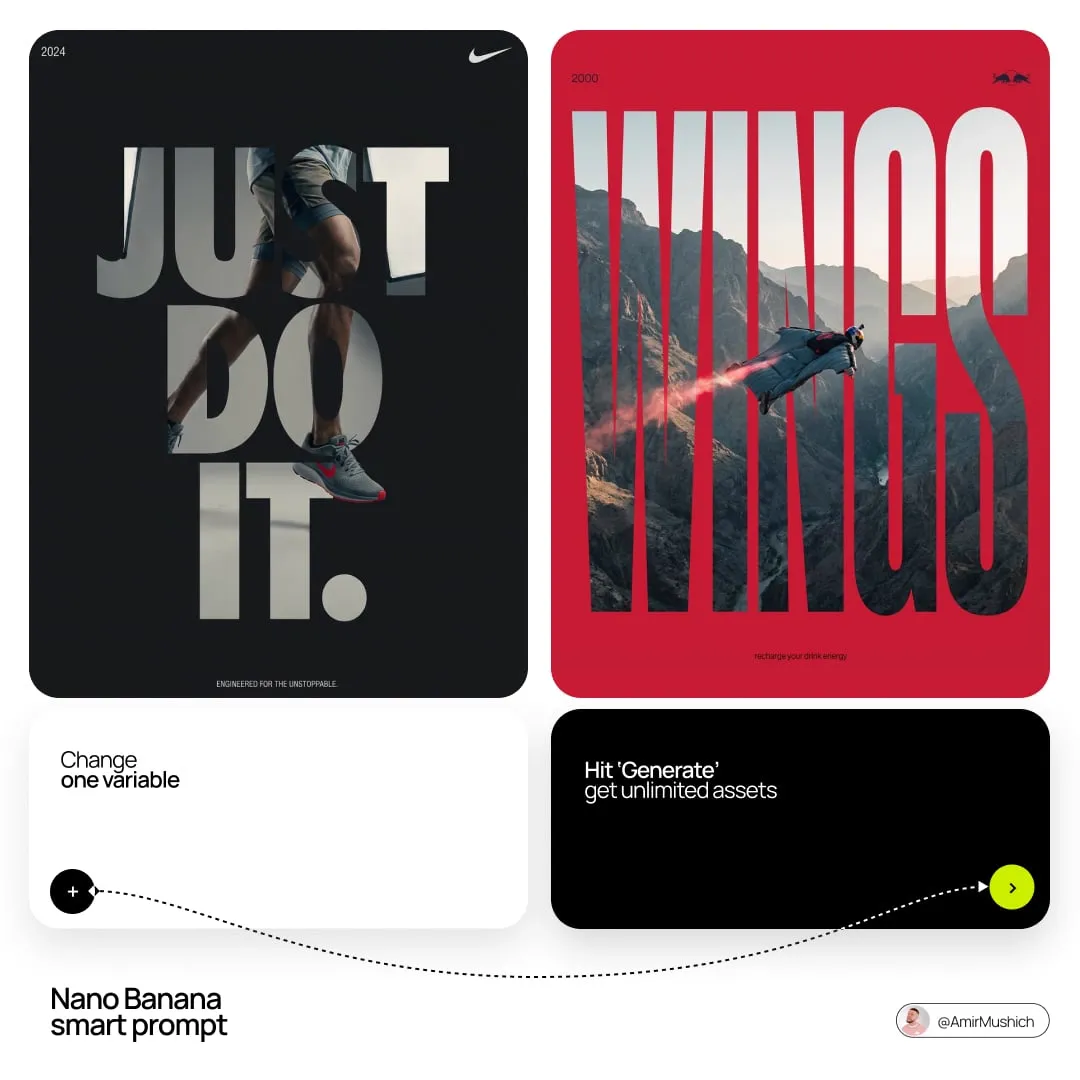
Keep an identity block — four or five lines describing the presenter, wardrobe, palette, and light — in a notes file, and paste it into every generation. Build a small library of shot structures you reuse: talking head, product reveal, environmental establishing shot, detail insert. Starting from a known structure rather than a blank prompt is the single biggest time saving in an AI-assisted workflow, and it keeps your clips visually related. Browse the prompts library for structures you can adapt, and start from Templates when you need a consistent opening and closing sequence.
Aspect ratio and safe zones
Vertical is the default for short-form. Shoot with generous margins and keep faces and text away from the top and bottom edges, where interface elements sit. Export one ratio, one caption style, one font, one caption position, and keep them across platforms. If you also publish landscape versions, reframe deliberately instead of cropping blind — a reframe preserves the composition you designed, a crop usually decapitates it.
Script architecture for 30 to 60 seconds
A short video is an argument, not a monologue. Three beats are enough.
The first two seconds
Open on the payoff, the contradiction, or the stakes. “Your portfolio is not the problem” outperforms “Hi everyone, today I want to talk about portfolios.” If the visual is unusual — a location you could not physically access, an unexpected prop, a striking generated shot — let the image carry the hook while the voiceover lands the sentence. Write the hook last. You will only know what it is once the rest of the script exists.
The middle: tension and proof
Name one problem in the viewer's language, then pay it off with one example and one number. Specificity is the entire game: “we cut delivery time from eleven days to four” beats “we significantly improved efficiency”. Cut any sentence that could belong to any creator in your field. If a line survives that test, it is usually because it names a constraint, a cost, or a decision — keep those.
The ending: one ask
Ask for exactly one thing: follow for part two, save the clip, comment with your situation, or visit the full breakdown. Two requests cancel each other out. The closing frame is also the right place to reinforce your signature — same background, same sign-off, same final beat.
An example rewrite, before and after:
- Before: “Hey guys, in this video I want to share some tips about storytelling that I think will really help you improve your content.”
- After: “Most short videos lose viewers around second four, and it is almost always the same reason: the setup arrives before the promise. Here is the fix we use on every client script.”
Same idea, twenty seconds shorter, and the promise arrives first.
What to generate and what to film
The most expensive mistake in an AI-assisted personal brand is generating everything. The second most expensive is filming everything.
When to pick up a camera
Film when your face is the value, when tone matters more than spectacle, when you are demonstrating something physical, or when the audience needs evidence that a real person stands behind the claim. Testimonials, medical and financial claims, and anything implying personal experience you did not have belong on camera — or they do not belong in the video at all without clear disclosure.
When to generate
Generate when you need a place you cannot access, a scale you cannot afford, a visual metaphor for something abstract, or five variations of one idea to test before committing production time to it. Generation also excels at the connective tissue that keeps an edit interesting: establishing shots, inserts, transitions, and abstract backgrounds that would otherwise eat an afternoon of stock searching.
| Intent | Shoot on camera | Generate | Best hybrid |
|---|---|---|---|
| Explain a decision | Yes — a face builds trust | Background plates | Open on camera, cut to generated b-roll |
| Show a physical method | Yes | No | Camera only |
| Illustrate an abstract idea | No | Yes | Generated sequence under voiceover |
| Test five hooks quickly | Optional | Yes | Generated variations, film the winner |
| Establish a location you cannot reach | No | Yes | Generated establishing shot, then camera |
The hybrid structure is usually strongest: open on camera to establish the human, cut to generated footage while you explain, and return to camera for the closing line. Trust stays intact and your visual range expands.
A weekly production system that survives real life
Structure turns inspiration into output. This sequence fits a two-hour block, once a week, for four to six clips.
- Collect raw material (10 minutes). Keep one running note: questions clients ask, objections you hear, small wins, things you disagreed with this week. Twenty lines of notes can become five videos; nothing else fills a content calendar as cheaply.
- Write hooks first (20 minutes). Draft five hooks before writing a single full script. If a hook does not create curiosity in one sentence, no script will rescue it.
- Draft to a timer (25 minutes). Read each script aloud. If it runs past sixty seconds, cut the setup, never the proof.
- Turn each script into a shot list (15 minutes). Mark which shots need you on camera, which are generated, which are screen recordings, and which are stills you will animate.
- Batch visuals (40 minutes). One session for generated visuals, one for filming. Batching protects your lighting, your wardrobe, and your identity block from drifting between clips.
- Assemble, caption, and level (25 minutes). Aim for consistent loudness and a caption size that reads on a phone at arm's length. Export one master file you can reuse across platforms.
- Publish and label (5 minutes). Record the hook type, the pillar, and anything odd about retention. The label takes seconds and is what makes month-two decisions possible.
Two habits make this durable. Publish the same master edit everywhere and adjust only what the surface requires — caption placement, ratio, first frame. And keep one voice: alternating between your own recording and a synthetic narrator every other week destroys the familiarity you have been building. If you use a generated voice, choose it once and stay with it.
Mistakes that quietly stall momentum
- Chasing trends instead of pillars. A viral clip with no through-line brings strangers who never return, because they cannot tell what you are about.
- Explaining instead of showing. If the outcome can be demonstrated in four seconds, demonstrate it before you narrate it.
- Changing your look weekly. New palette, new framing, new font — recognition resets to zero each time.
- Too many messages. One idea per video, even when you have five good ones. Split them across a week.
- Treating the hook as an editing problem. It is a writing problem. No transition fixes a first sentence that promises nothing.
- Publishing without captions. Silent viewing is the default, and on-screen text also makes your content searchable and usable by people who rely on captions to follow audio.
- Judging the strategy after one clip. Patterns show up somewhere between twenty and thirty published videos, not three.
- Generating everything. A feed with no human signal feels like a stock library, however polished the shots are.
- Never reusing anything. If a clip worked, its structure is an asset. Rebuild the same beat with new substance before inventing a new format.
Measuring what worked
Five numbers tell you most of what you need: three-second retention, completion rate, saves and shares, profile visits, and conversations started. Read them in pairs rather than alone, because each pair isolates a different problem.
High three-second retention with low completion means the hook is strong and the middle drags — shorten the setup. High completion with few profile visits means the content is pleasant but not clearly yours — sharpen the promise in the first line and the closing frame. Strong saves with weak follows suggests you are producing reference material, which is genuinely valuable, so pair it occasionally with a clip that shows who you are and what you believe.
Track results by pillar, not by individual video. After four weeks you will usually find that one pillar drives saves, another drives follows, and a third drives enquiries — three different jobs, three different formats. That is the point at which you stop guessing and start scheduling.
FAQ
Do I need to appear on camera?
No. Many strong personal brands are built without a face on screen. What you cannot skip is consistency: one visual signature, one voice, one promise. If you use a recurring generated presenter or an animated identity, treat it as a brand asset and keep it identical clip to clip. Where a synthetic presenter could mislead — testimonials, health or financial claims, experiences you did not have — disclose it or record it yourself.
How often should I publish?
Choose the highest cadence you can hold for eight weeks without dropping quality. Two reliable clips a week beat six in one week followed by silence. Consistency is what lets a platform treat you as an active account, and consistency is what builds viewer expectation.
What length works best?
Match length to intent. A single insight needs twenty to thirty-five seconds. A case study needs forty-five to seventy-five. A framework can run past ninety if the first thirty seconds stand alone as a complete idea. The unhelpful question is what the algorithm prefers; the useful one is how long this particular idea takes to land.
Can a generated presenter build real trust?
Yes, when the substance is genuinely yours and the character stays stable. Viewers forgive synthetic visuals far more readily than they forgive generic advice. Trust comes from specificity, not from pixel provenance.
How do I stop AI visuals from looking generic?
Replace mood words with camera language. Specify lens, distance, subject action, lighting direction, and what the frame excludes. Reuse your identity block and palette every time. Generate more frames than you need and choose the ones that resemble your brand rather than the ones that merely look impressive.
How long before this produces results?
Expect the first ten clips to be calibration rather than performance. You are learning your hooks, your pillars, and your editing rhythm. Between twenty and thirty published videos, patterns usually appear: one hook style outperforms, one pillar earns saves, one format starts conversations. Then you double down instead of restarting.
Make the next clip, not the perfect plan
A personal brand built on short video is not a treadmill. It is a small system: one promise you can say in a sentence, three pillars you rotate, one visual signature people recognise, and a weekly block that turns notes into published clips.
AI shortens the distance between the idea and the finished frame, which is where most of the friction lives. Orelon is an AI video generator for cinematic ideas in motion — start with Create Video to turn a script into shots, lock your look with Create Image, and borrow reliable structures from the templates gallery. Then publish the next clip instead of planning it.