

Learn how lens choice, depth of field, framing, camera movement, and lighting from iconic films translate into precise AI video prompts.
Cinematography is a chain of small decisions that add up to a feeling. A lens is chosen, the camera is placed at a specific height, a lamp is moved two feet to the left, and suddenly a hallway feels hostile instead of neutral. The techniques that made iconic films iconic are not secrets — they are repeatable patterns. Once you can name them, you can also instruct them.
That skill matters more than ever now that a growing share of shots are generated rather than photographed. A generative model will happily produce something pretty. It will only produce something directed if you tell it which patterns to follow. This guide breaks down the camera language of classic and modern cinema — lens, depth of field, framing, movement, and light — and shows how to convert each one into instructions that survive the trip from idea to final render.
The four variables behind every memorable frame
Strip away the story and every shot in film history is a combination of four controllable variables:
- Lens and perspective — how much space is compressed or exaggerated, and how close the audience feels to the subject.
- Framing and distance — what is inside the rectangle, what is deliberately left out, and where the subject sits within it.
- Movement — whether the camera is still, gliding, trembling, or descending from the sky.
- Light — direction, hardness, color, and the ratio between the lit and unlit parts of a face.
A fifth variable, time, quietly governs all four: how long a shot holds, whether it plays at speed or slow motion, and when it cuts. Most beginners fixate on subject and setting. Most professionals spend their energy on these five variables instead, because subject and setting are the cheapest things to change.
The same hierarchy applies when you generate footage. A prompt that describes a woman in a red coat in a forest gives the model almost nothing to work with. A prompt that describes a woman in a red coat, framed in a medium-wide shot on a 40mm lens, camera locked off at chest height, hard side light from a window camera-left, mist compressing the background — that is a shot.
Lens choice is emotional grammar
Lens selection is the fastest way to change how an audience relates to a subject, and it happens before a single line of dialogue.
Wide lenses: proximity, distortion, unease
Wide glass pushes the foreground toward the viewer and stretches the background away. Faces gain a slightly bulbous, vulnerable quality when the camera is close. Corridors become tunnels. In The Shining, the steadicam glide through the Overlook's corridors works because a wide lens exaggerates the geometry and makes the space feel like it is leaning in. Terry Gilliam built an entire visual identity on extreme wide angles that make rooms look insane.
Use wide lenses when you want the environment to participate in the scene, when you want physical comedy or physical threat, or when you want the viewer to feel inside the action rather than watching it.
Long lenses: compression and intimacy at a distance
Telephoto glass flattens depth. Backgrounds stack up behind the subject like layered cards, crowds become texture, and heat haze becomes a character. Michael Mann shoots city nights on long lenses so the skyline presses down on his characters. A close-up on a long lens is intimate without being aggressive — the camera is far away, which lets actors forget it is there.
Use long lenses when you want isolation, surveillance, romantic compression, or the sense that the world is crowding the subject.
How to write lens language into a prompt
Abstract adjectives like “cinematic” do nothing. Physical descriptions do a lot:
- “85mm portrait compression, background bokeh, subject sharply isolated”
- “14mm ultra-wide, close to the ground, exaggerated perspective, ceiling bowing inward”
- “200mm telephoto, layered silhouettes in the foreground, compressed skyline behind”
If you only specify one technical detail per shot, specify the lens. It changes more of the frame than any other single word. For more examples of how focal length reads on screen, browse the Seedance 2.5 examples and compare how the same subject behaves at different focal lengths.
Depth of field as narrative emphasis
Depth of field tells the audience where to look. Shallow focus isolates a face against a soft field of color; deep focus forces the eye to travel through the frame and choose its own subject. Citizen Kane is the canonical deep-focus film — foreground, midground, and background all sharp, all carrying information, all demanding attention at once.
Racking focus is a cut that happens inside a shot. The camera does not move, but attention transfers from a glass on the table to a face in the doorway. It is one of the most efficient storytelling tools in cinema because it costs nothing in coverage.
Generative models tend to default to a mid-aperture look: everything slightly soft, nothing decisively sharp. Counter that by being explicit:
- For isolation: “shallow depth of field, f/1.4 look, only the eyes in focus, background falling into soft bokeh.”
- For deep focus: “everything sharp from foreground to far wall, deep focus, no bokeh, architectural clarity.”
- For a rack: “focus begins on the foreground object, then shifts to the figure in the doorway.” Focus pulls are hard for models; expect to generate several attempts and keep the cleanest one.
Framing: symmetry, negative space, and the rule of thirds
Framing is where personal style becomes visible. Stanley Kubrick's one-point perspective places the subject dead center with vanishing lines converging behind them, creating a sense of order that is usually about to break. Wes Anderson flattens space entirely with planimetric framing — camera perpendicular to the wall, subject centered, symmetry absolute. No Country for Old Men does the opposite, leaving vast negative space in the frame so the landscape feels indifferent to the violence inside it.
The rule of thirds is a useful default, not a law. Try these framing decisions in sequence and notice how each one changes the emotional temperature:
- Centered and symmetrical — control, formality, unease.
- Subject on the far third, empty space ahead — anticipation or loneliness.
- Subject low in frame, sky above — vulnerability or insignificance.
- Subject high in frame, ground below — dominance or detachment.
Also decide your aspect ratio before anything else, because it changes composition logic. Anamorphic 2.39:1 wants horizontal staging and wide landscapes. 1.85:1 is a flexible middle ground for dialogue. Vertical 9:16 is not a crop of a widescreen image — it needs centered subjects, vertical leading lines, and much tighter framing. Decide early; retrofitting a horizontal composition into a vertical frame never looks intentional.
Camera movement defines genre and mood
Movement is the most misused tool in generated video. A camera that moves for no reason reads as decoration. A camera that moves because a character moves, or because the audience is being pulled toward a realization, reads as direction.
Tracking and dolly shots
A dolly physically moves the camera through space; a tracking shot follows a subject. Together they create the sensation of travelling with someone. The long, unbroken tracking shots in Children of Men work because the camera never blinks — the audience is denied the relief of a cut, so tension accumulates without release.
For generation, describe the movement in terms of start and end position, not just the verb: “camera tracks backward at walking pace, keeping the subject centered, corridor receding behind her.” That is far more controllable than “tracking shot.”
Crane and aerial: establishing scale
A crane rise or a drone pull-back tells the audience how big the world is relative to the character. Blade Runner 2049 uses vast vertical reveals to make individuals look like specks inside infrastructure. The movement is slow, usually one direction, and almost always ends on a wide composition.
Use crane and aerial language sparingly. One scale reveal per sequence lands; five in a row cancel each other out.
Handheld and shaky cam: instant realism
The handheld camera arrived as a documentary tool and became a genre signature. Mad Max: Fury Road centers its action inside a jittering frame so the audience feels physically inside the chase. The effect only works if the shake is motivated — it should feel like a person running with a camera, not a random noise algorithm.
Describe it as an operator behavior: “handheld camera, slight breathing motion, occasional reframing to keep the subject in frame, no whip pans.” Vague requests for “shaky cam” usually produce nauseating, unusable footage.
When stillness is the move
Locked-off frames are underrated. A static camera with strong composition and good blocking lets performance and production design do the work, and it is far easier to control in a generative workflow. If a shot does not need movement, removing it will usually improve the result.
Light builds atmosphere before the subject does
Three-point lighting and its variations
Classical three-point lighting — key, fill, back — exists to make a subject legible and dimensional. Its variations are where style lives:
- High key: strong fill, minimal shadow, bright and even. Comedy, commercials, dream sequences.
- Low key: minimal fill, deep shadow, high contrast. Thriller, noir, dread.
- Rembrandt: key at roughly 45 degrees, a small triangle of light on the shadowed cheek. Portraiture and introspection.
- Backlit silhouette: the subject becomes shape rather than face. Mystery or grandeur.
Hard versus soft, and motivated sources
Hard light creates crisp shadow edges and reads as sun, bare bulbs, or streetlights. Soft light wraps and flatters. The most cinematic choice, though, is motivation: every source should have a visible reason to exist. A window, a neon sign, a television, a car's headlights. When light is motivated, the audience stops noticing it and starts believing the room.
Practicals — lamps, screens, and signage that appear in the frame — are especially useful in generated footage because they give the model a visible light emitter to build reflections and falloff around. Write them in: “single desk lamp camera-left casting hard shadow on the wall, cool blue monitor glow on the face, no other sources.”
Color temperature contrast is another cheap and powerful tool. Warm interior against cool exterior, sodium streetlight against moonlight. Two colors, one frame, immediate depth. If you want to explore how lighting language behaves across iterations, the prompt library is a good place to compare setups side by side.
A repeatable workflow: from reference to render
Technique is only useful if it survives production. Here is a workflow that keeps cinematic intent intact from first idea to final clip.
Build a reference board of stills, not scenes
Collect frames, not clips. Stills force you to analyze composition, contrast, and light direction rather than vibes. For each reference, write one sentence describing why it works: “low angle, wide lens, single hard source from the left, subject small in a large negative space.”
Write the shot as a single sentence
Subject, action, framing, movement, light. One sentence, no adjectives about quality. “A courier steps off a tram into rain, medium-wide on a 35mm lens, camera locked off, hard streetlight from behind creating a rim, wet pavement reflecting sodium orange.”
Split the sentence into controllable fields
Most generation interfaces respond well to separated inputs: subject, environment, camera, lighting, mood, duration. Keeping them separate makes it possible to change one variable without destroying the rest.
Generate short, keep moves simple
Two to five seconds per clip is usually enough. Complex choreography — a character walking through three rooms while the camera orbits — fails far more often than a single motivated move. Build sequences from simple, well-controlled pieces.
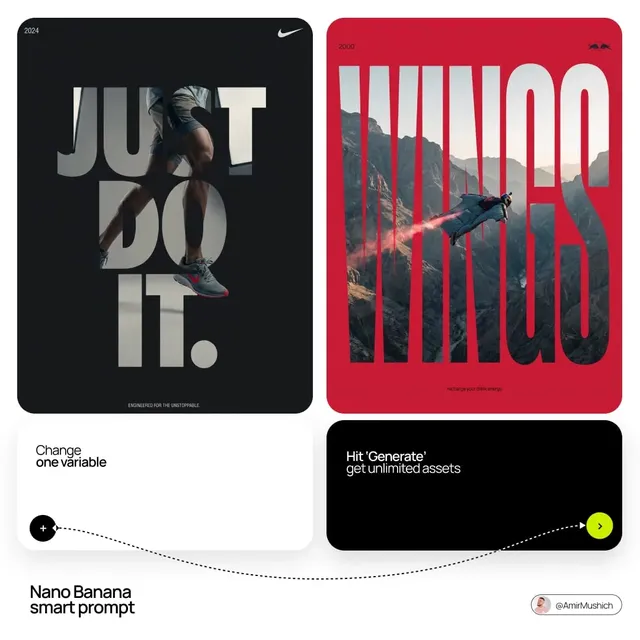
Change one variable per iteration
If you change lens, lighting, and movement at once, you learn nothing. Lock two, vary one, compare. This is the same discipline a photographer uses with a light meter, and it is the fastest way to build intuition about how a model interprets language.
Assemble, then grade for continuity
Shots generated separately rarely match in color and contrast. A single grade — consistent black level, consistent white balance, a shared shadow tint — will do more for the illusion of a real scene than any individual shot. Templates can help here; the video templates collection shows how a fixed look applied across shots creates continuity.
Common mistakes that flatten generated footage
- Stacking adjectives instead of physical facts. “Epic, cinematic, beautiful, 8K” communicates nothing. “Low angle, 24mm, hard backlight, dust in the air” communicates everything.
- Unmotivated movement. If the camera moves, something in the scene should justify it.
- No depth layering. A frame with only a subject and a flat background looks like a graphic. Add foreground elements, midground action, and a distant plane.
- Inconsistent lens across a sequence. Switching from ultra-wide to telephoto between adjacent shots breaks spatial logic.
- Overlighting. Filling every shadow removes the contrast that makes an image feel photographed.
- Ignoring aspect ratio. Compose for the delivery format from the first frame.
- Describing a famous shot by name. Models do not recognize titles. Describe the technique instead — the lens, the angle, the light — and you will get far closer to what you meant.
Building a shot list a model can follow
A shot list is the bridge between taste and execution. Keep it short and explicit. A workable structure looks like this:
| Shot | Lens | Framing | Movement | Light | Purpose |
|---|---|---|---|---|---|
| 1 | 24mm | Wide, subject small | Locked off | Backlit haze, cool | Establish scale |
| 2 | 50mm | Medium, centered | Slow push in | Warm practical, hard | Introduce subject |
| 3 | 85mm | Close-up | Static | Soft key, low fill | Emotional beat |
| 4 | 35mm | Medium-wide | Handheld follow | Mixed sodium and blue | Transition to action |
Notice how the lens progression does narrative work: wide to introduce, normal to observe, long to feel. That is a century-old pattern and it still reads instantly.
FAQ
Do I need film school knowledge to use these techniques? No. You need four words you can control: lens, framing, movement, light. Everything else is variation. Learn to describe those four precisely and your output will improve faster than by watching another hundred hours of analysis.
Which camera movement is safest to start with? Locked off, then slow push in. Static frames with strong composition succeed far more often than complex choreography, and a slow push reads as intentional even when the model's timing wobbles.
How do I keep visual consistency across multiple generated shots? Fix three things and repeat them verbatim in every prompt: lens family, lighting direction, and color palette. Then unify in post with a shared grade. Consistency is mostly repetition plus correction, not luck.
Should I use a real film as a reference? Use it as study, not as a template. Analyze why a frame works, write that down in technical language, then build your own shot from those principles. Reproducing a specific frame is both less interesting and less reliable than applying its logic.
How long should each generated clip be? Short enough that a single idea fits: two to five seconds for action beats, up to eight for atmosphere. Long clips invite drift in faces, props, and lighting, which is exactly the continuity you are trying to protect.
Where does sound fit into this? Sound is half of cinematography's effect. A slow push feels different with a low drone than with silence. Plan audio alongside the shot list so the movement has something to land against.
Start with one shot, not one film
The most useful thing you can take from a century of iconic camera work is not a list of famous frames — it is the habit of describing images in physical terms. Lens, framing, movement, light. Make those four decisions deliberately, write them down, and change one at a time until the frame matches the idea in your head.
That is exactly how Orelon is built to be used: cinematic ideas in motion, with control over the details that actually shape a shot. Open the AI video generator, take a single reference still, write one sentence with a lens, a framing, a movement, and a light source, and generate. Then do it again with one variable changed. Ten iterations of that exercise will teach you more about cinematography than any shot you copy.