
Learn how to prompt AI video generation for clean, compressible footage, then export and deliver it as disc-ready files without losing quality.
Most AI video projects do not fail at the model. They fail at the handoff. A clip renders beautifully, gets approved in a browser preview, and then falls apart somewhere between the export and the screen it was actually meant for — a classroom projector, a competition submission drive, a living-room disc player, or an archive drive that needs to still open in ten years. The footage was fine. The pipeline around it was not.
This guide treats AI video as two connected disciplines. First, prompting and generating clips that hold up under scrutiny and compression. Second, moving those clips out of their original container into delivery formats — including disc-based ones — without quietly destroying the quality you just spent hours producing. Neither half is difficult once you know where the traps are, but the traps are consistent and expensive to fix late.
Decide the delivery format before you write a single prompt
The most common ordering mistake in AI video work is generating first and asking delivery questions later. By then your clips have locked in a frame rate, an aspect ratio, a grain level, and a motion style. Some of those choices are easy to change. Others mean regenerating everything.
Delivery targets impose hard constraints:
- Aspect ratio. A 16:9 master letterboxes awkwardly into a 4:3 presentation and crops badly into vertical social formats. If you need both, you need a wider original framing with headroom at the center.
- Frame rate. Editing masters are happiest at a constant 24, 25, or 30 fps. Delivery formats overwhelmingly expect constant frame rate. Generation tools sometimes output variable frame rate files, and that mismatch causes audio drift and duplicated frames much later in the process.
- Runtime budget. A two-hour program fits comfortably on single-layer disc media at moderate bitrate. A three-hour program forces you down to bitrates where grain and fast motion smear.
- Motion style. Slow, deliberate camera movement encodes cleanly. Aggressive handheld motion and rapid cuts demand bitrate that standard-definition delivery simply does not have.
- Text safety. Subtitles and lower-thirds baked into the frame cannot be repositioned later. Keeping text out of the render preserves your options.
Write a one-page delivery brief before generating anything. Runtime, aspect ratio, target frame rate, primary format, secondary format, and the audience. It takes ten minutes and saves entire weekends.
Why compression punishes some AI clips much harder than others
Every delivery format re-encodes your footage. Re-encoding is lossy by nature, and it spends its limited resources on whatever moves. That means certain visual choices cost dramatically more than others.
Textures that punish low bitrate: heavy film grain overlays, falling rain, drifting snow, confetti, dense foliage in wind, fire embers, rippling water filling the frame, and crowds of small moving figures. Each of these is high-frequency detail, and encoders will either spend enormous bitrate preserving it or smear it into blocky mush.
Motion that punishes low bitrate: whip pans, fast dolly moves through cluttered environments, rapid zoom, and handheld jitter that reads as instability rather than style. A slow push-in on a still subject is nearly free. A sprinting camera through a market is not.
Lighting that punishes low bitrate: crushed blacks with detail hidden inside, extreme gradients across a sky, and strobing practical lights. Banding appears first in smooth gradients, and it is very hard to remove after the fact.
The practical takeaway is not to avoid these elements. It is to use them as accents rather than as the entire frame. A rain-slicked street with a mostly static subject is fine. Ten seconds of nothing but cascading water is a compression problem wearing a cinematography costume.
Prompting AI video so the footage survives the pipeline
A prompt that produces one beautiful clip is a trick. A prompt structure that produces forty consistent clips is a production system. The difference is specificity about things that actually direct the image.
The seven building blocks
Every strong video prompt answers these questions, roughly in this order:
- Subject — who or what, described with concrete physical detail instead of mood adjectives.
- Action — one clear verb in present tense, happening inside the clip.
- Setting — location, time of day, and weather, because those three drive the lighting.
- Camera — shot size, angle, and movement, or an explicit statement that the camera is locked off.
- Lighting — source direction and quality. Soft window light from camera left. Hard overhead sun. Warm practical lamp from behind the subject.
- Look — lens character, color palette, contrast, and grain level.
- Constraints — duration, what must not appear, and anything that has to match a previous shot exactly.
A weak prompt next to a working one
Weak: 'a woman walking through a city at night, cinematic, 4k, masterpiece, ultra detailed.'
Every word there is either a mood or a wish. Nothing directs the camera, the light, or the motion, so the model guesses, and it will guess differently every render.
Working: 'Medium-wide tracking shot, camera moves slowly right to left at walking pace. A woman in a charcoal wool coat walks along a wet cobblestone alley at night, hands in pockets, visible breath. Magenta neon signage on the left rim-lights her shoulder; a single warm lamp glows at the far end of the alley. Shallow depth of field, 40mm equivalent lens, fine grain, muted teal and amber palette. Steady and unhurried, no other people in frame.'
The second version specifies composition, movement speed, light direction, palette, and lens character — and it encodes cleanly, because nothing in it is high-frequency chaos.
Change one variable per render
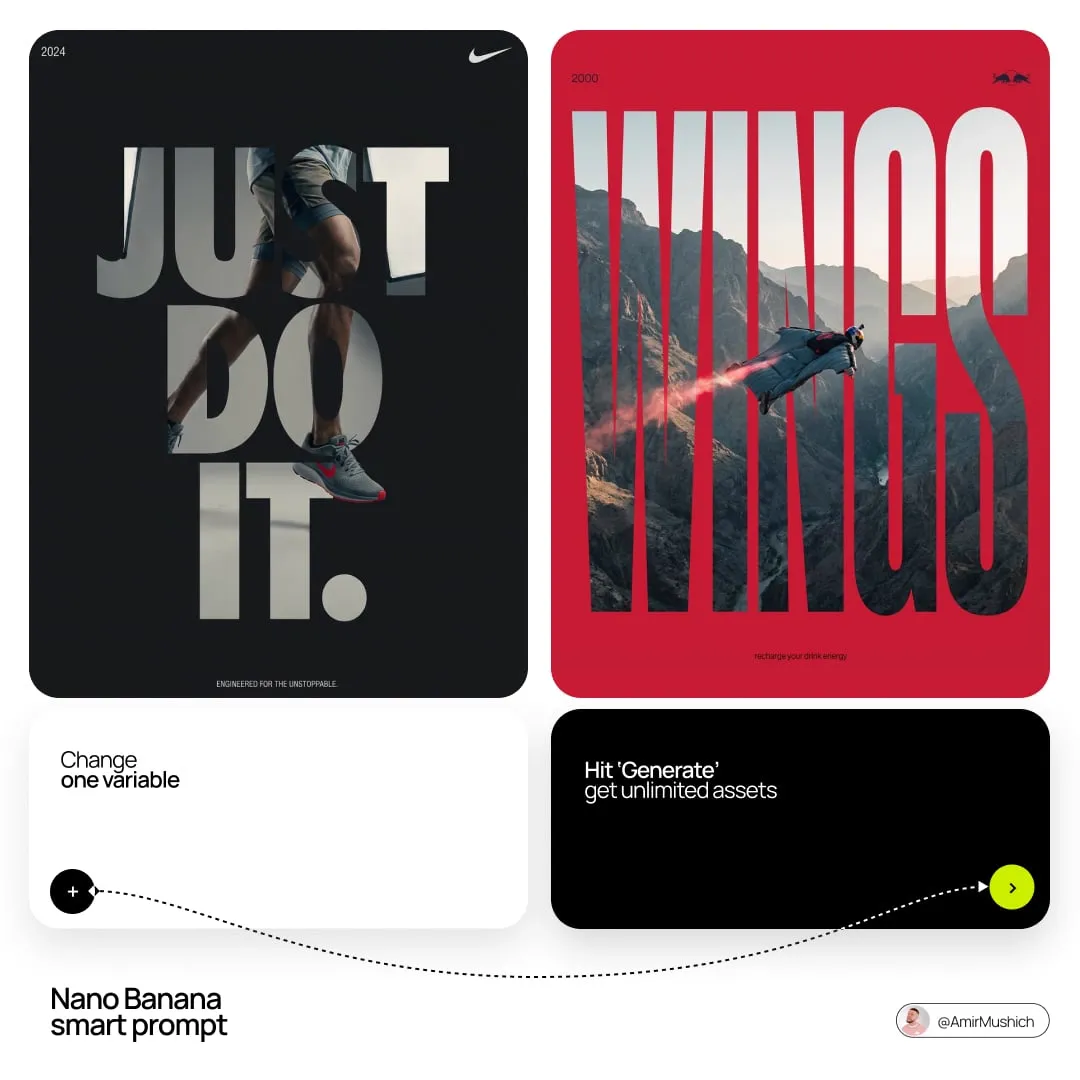
If you alter the lens, the lighting, and the action in the same pass, the result teaches you nothing. Change one thing, note what happened, change the next thing. Keep a simple two-column log: what changed, what it did. After a few dozen clips, that log is more valuable than any generic cheat sheet, because it describes your project rather than someone else's taste. Building a personal prompt library around it makes the knowledge reusable across projects.
Lock the look with a still before you animate
Composition is cheap to iterate as an image and expensive to iterate as video. Approving a still first means you settle framing, wardrobe, palette, and lighting in seconds, then animate the frame you already like. Tools like Orelon's AI image generator exist for exactly that staging step, and passing an approved frame into the AI video generator keeps the look coherent across shots.
It also improves collaboration. 'Like this frame, but the camera drifts left' is a note a client, editor, or composer can act on immediately.
Reuse structure with templates
When a look works, save it as a reusable structure with the variables marked. Templates cut decision fatigue on long projects and keep a series visually consistent — the same palette, the same grain, the same lens character, with only the subject swapped. Starting from video templates is faster than rebuilding a look from memory and hoping you match it.
Export settings that determine everything downstream
The single largest cause of poor delivery output is a poor export upstream. Fix the export and the conversion steps become boring, which is exactly what you want.
Container, codec, and the MP4 misunderstanding
MP4 is a container, not a codec. Inside an MP4 you might find H.264, H.265, AV1, or something else, each with different compression behavior, plus a separate audio stream. When someone says the file is too big or looks soft, they are describing the codec and bitrate inside the container, not the container itself.
Disc authoring tools generally decode your file and re-encode it to a much older, much less efficient video format. That means your export should be clean and lightly compressed. Aggressively squeezed source files have already thrown away detail that the second encode cannot recover.
Bitrate targets worth writing down
| Source | Purpose | Target video bitrate |
|---|---|---|
| 1920×1080 at 24–30 fps | Authoring master | 20–40 Mbps |
| 1920×1080 | General editing master | 12–20 Mbps |
| 3840×2160 | Archive master | 50–80 Mbps |
| 1080×1920 | Vertical derivative | 10–16 Mbps |
Non-negotiable export habits
- Constant frame rate. Not optional. Variable frame rate sources cause audio drift and duplicated frames in authoring tools, and the symptoms look like software bugs rather than source problems.
- No burned-in text. Subtitles as pixels cannot be repositioned for a different aspect ratio.
- No baked-in letterboxing. Decide the aspect ratio once, in one place.
- Rec. 709 color. Standard for anything headed to a conventional video delivery chain.
- 48 kHz stereo audio at consistent loudness. Normalize spoken content to a comfortable level and keep music beds a few decibels beneath it.
- Trim silence at head and tail. Dead air at the start reads as a broken file.
What disc-based delivery actually demands
Streaming dominates attention, but disc delivery never disappeared. Classrooms without reliable internet, competition submissions that require a physical format, archive copies meant to outlive a subscription, and gifts that feel more personal on a disc all keep the format alive.
The technical envelope is narrow and worth knowing:
- Resolution. 720×480 for NTSC, 720×576 for PAL. Standard definition, not high definition.
- Video format. An older MPEG-style codec, encoded into VOB files.
- Bitrate ceiling. Roughly 9.8 Mbps combined across video, audio, and subtitle streams. Audio is not free; a busy menu and multiple audio tracks eat the same budget as the feature.
- Audio formats. AC-3, DTS, or PCM, depending on player expectations.
- Aspect ratio. Either 4:3 or 16:9 anamorphic, which means non-square pixels. A 16:9 image is stored squeezed and stretched back out on playback.
- Structure. Menus, chapters, and region coding are part of the specification, not optional extras.
Capacity arithmetic you can do in your head
Single-layer media holds about 4.7 GB. Dual-layer holds about 8.5 GB. At 6 Mbps video plus 384 kbps audio, roughly two hours fits comfortably on a single layer. Push beyond that and you either drop to 4–5 Mbps — where grain and fast motion begin to smear — or move to dual-layer media and accept that some older players handle the layer break poorly. Placing a chapter marker at the layer break is a small courtesy that prevents visible hiccups.
Why slow AI camera moves win here
Standard-definition encoding with a tight bitrate ceiling simply cannot track fast motion. This is the same compression logic from earlier, applied with a much smaller budget. Clips built around slow pushes, gentle parallax, and locked-off compositions look intentional and clean at 6 Mbps. Clips built around sprinting cameras look like the format failed. Plan coverage accordingly, and shoot the action-oriented material for a format that can carry it.
Choosing conversion software: decision criteria
There is no universally best tool, only a best fit for how you work.
Authoring depth
Does it support custom menus, chapter markers, multiple audio tracks, and subtitle import? For a straight play-through disc, a minimal tool is fine. For a classroom, a distributor, or a festival jury, chapter navigation is the baseline expectation.
Encoding control
Two-pass variable bitrate encoding with a manually set maximum is the minimum for anything you care about. Tools that expose only a vague quality slider hide decisions that will eventually surprise you. Check whether the encoder deinterlaces properly and whether it preserves your source frame rate instead of silently forcing 29.97.
Reliability and honest testing
Test the entire pipeline on a three-minute clip before trusting it with a two-hour program. Deliberately feed it a variable frame rate file and watch what happens. Burn at moderate speed on quality media — cheap blanks and maximum burn speeds cause more playback failures than any setting in the software.
Command line versus graphical tools
Command line utilities such as ffmpeg are excellent for normalizing footage: converting to constant frame rate, resampling audio, and re-muxing without re-encoding. Graphical authoring tools are better at menu design and chapter layout. Many experienced workflows use both, and there is nothing wrong with that.
A complete pipeline from idea to playable disc
- Write the brief. One page: runtime, audience, aspect ratio, frame rate, primary and secondary delivery formats, and the three shots you cannot live without.
- Generate stills. Approve composition, palette, wardrobe, and lighting before animating anything.
- Animate in short clips. Four to eight seconds per generation is the sweet spot: long enough to establish a moment, short enough to re-render without regret.
- Assemble and trim for rhythm. Cut structure first, technical polish second. A tight edit forgives slightly soft footage; a slow edit does not.
- Export a constant frame rate master. High bitrate, no burned-in text, no baked-in letterboxing.
- Normalize audio. Consistent loudness, 48 kHz stereo, silence trimmed at both ends.
- Author the project. Chapters every three to five minutes, one clean menu, two-pass encoding.
- Test on real hardware. A set-top player and an older television, not just a software player.
- Archive the master and the project file. Re-authoring because the menu file is missing is a genuinely miserable afternoon.
Common mistakes that cost a re-render or a re-burn
- Ignoring frame rate. Variable frame rate sources create audio drift that looks like an authoring bug.
- Over-sharpening before compression. Sharpening adds high-frequency detail, and encoders spend bitrate on detail. The result looks worse after encoding, not better.
- Baking subtitles into the frame. Once text is pixels, it cannot move.
- Expecting the burn step to fix bad footage. Encoding reveals problems. It does not create quality.
- Skipping chapters. A two-hour program with no navigation feels broken to anyone who did not make it.
- Testing only in software players. Playback software is far more forgiving than dedicated hardware.
- Discarding the project file. Always keep it alongside the master.
- Generating long clips to feel safe. Long AI clips drift in continuity and cost more to replace. Coverage beats duration.
FAQ
Do I still need disc delivery at all?
Only if your audience does. Discs make sense for classrooms without dependable internet, archives meant to outlive a service, competitions that require a physical submission, and gifts where a file link feels impersonal. If none of those apply, a well-encoded file is the better deliverable and it is cheaper to distribute.
What bitrate should AI-generated footage use for disc delivery?
Target 6–8 Mbps for the video stream on single-layer media with a runtime under two hours. Below 4 Mbps, grain and fast motion break down quickly. Above 8 Mbps you are consuming capacity for gains most viewers will not perceive on standard-definition hardware.
Can 4K footage go onto a disc?
Not in the conventional disc video format. A data disc can hold a 4K file, but a standard player will not play it. High-definition physical delivery requires a different disc format, different authoring software, and different player expectations. Plan on downscaling to 720×480 or 720×576 for the standard format.
How do I keep AI footage from looking mushy after compression?
Reduce high-frequency detail before encoding. Avoid heavy grain overlays, avoid rapid camera movement in wide shots, keep contrast reasonable so shadows retain some detail, and hand the encoder a clean high-bitrate master. A light noise reduction pass on the master often improves the final result more than any encoder setting.
Is a chat assistant useful for writing video prompts?
Yes, as a structuring tool rather than a director. It is good at turning a vague idea into the seven building blocks, generating shot lists, and keeping terminology consistent across a series. It cannot see motion, so it cannot judge whether a camera move reads well. You still review every render.
How long should each AI clip be?
Four to eight seconds per generated shot. That is long enough to establish a moment and short enough to re-render without regret. Build a long program from many short shots rather than a few long ones — it also gives you flexibility when one clip needs replacing.
What is the most common reason a burned disc fails in a player?
Aspect ratio and frame rate mismatches top the list, followed by media the player's laser cannot read reliably. Verify project settings before encoding, use quality blank media, and burn at moderate speed, and most of these failures disappear.
How do I keep a series visually consistent?
Lock a template before you start: lens character, palette, grain level, and lighting direction. Change only subject and action between shots. Consistency comes from constraints you choose once, not from consistency you hope for.
Build the shot properly and every format after it gets easier
Delivery cannot rescue weak footage, and strong footage cannot survive a careless pipeline. Both halves deserve the same attention, and the good news is that the fixes are procedural rather than technical. Write a delivery brief. Prompt with the seven building blocks. Approve a still before animating. Export one clean constant frame rate master. Derive everything else from it.
Start on the generation side. Orelon is an AI video generator for cinematic ideas in motion, built around the still-then-motion order that keeps a project coherent, with an Orelon blog full of practical technique when you want to go deeper. If you are weighing tools, a focused comparison such as Orelon versus Runway tells you more about workflow fit than a feature checklist ever will.